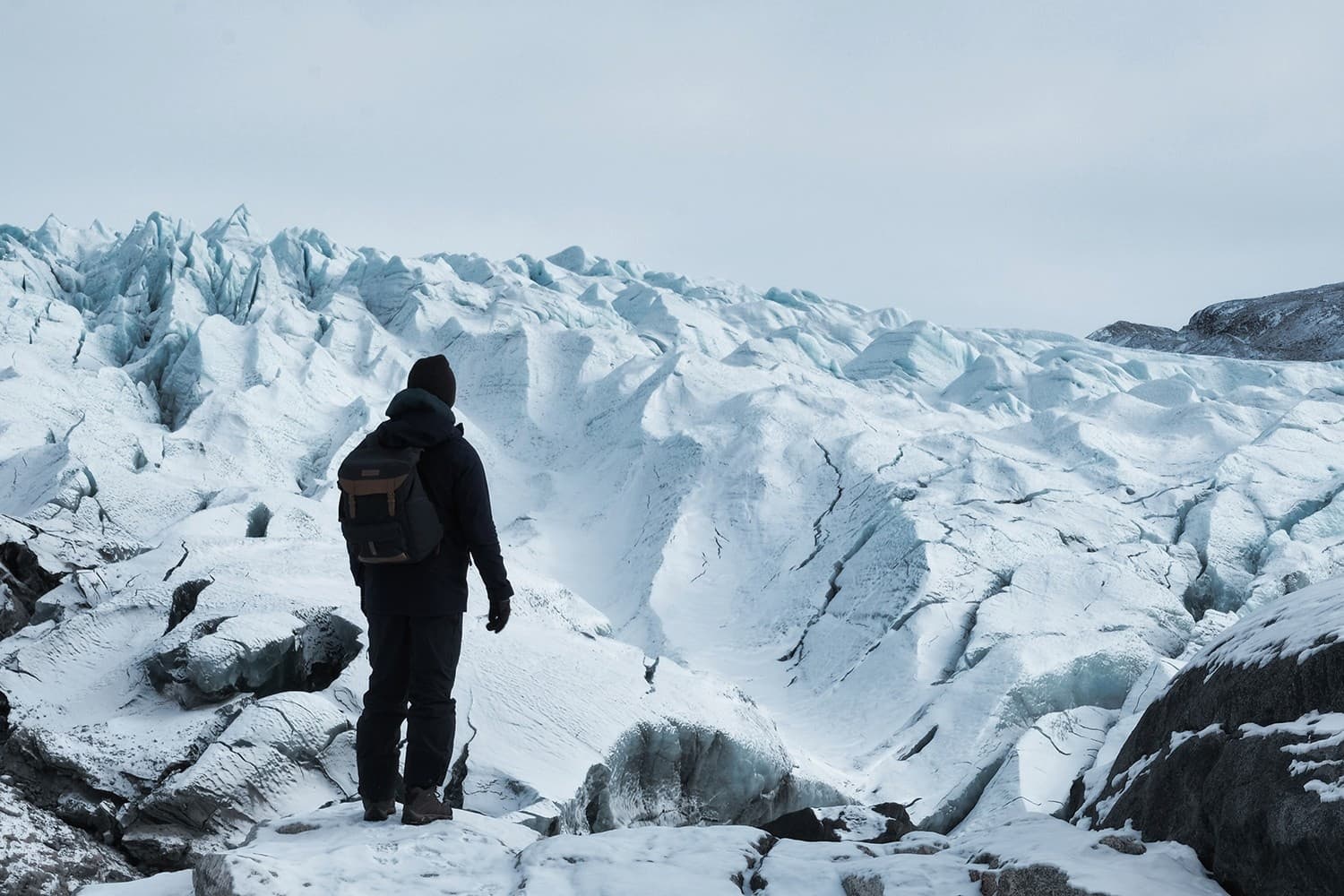
“I felt my ancestors were there on the sled with me.”
Klaus stops us without warning, his beard a glistening, icy appendage.
No cameras, he says. No talking. Just this.
We’re standing atop the Greenlandic ice cap after a few hours of crampon hiking along its edge – 656,000 square miles of frozen expanse stretching east toward a coast most humans will never see. The average thickness beneath our feet is over 5,000 feet. From north to south, Klaus tells us, the ice cap spans roughly the distance from Denmark to Spain.
The cold has been relentless all week, as is the norm here outside of summer. You keep moving or you start freezing, no matter how many layers you have on. My facial hair has frozen solid, as has Klaus’.
What follows is the quietest moment of my life. No wind or wildlife. No ambient hum of civilization. Just cold, pale light and ice that has been here for millennia – and, according to every climate scientist currently racing to study it, that is slowly fading away. NOAA reports Greenland has been losing ice year over year for more than a quarter century. The University Corporation for Atmospheric Research puts the current loss at 234 billion tons per year.
I don’t often get emotional in nature. But standing at the edge of something this vast and this fragile, I have to admit: I got a little verklempt.
Meanwhile, back in the news cycle, the world is arguing about who gets to own a place that’s older than humanity.
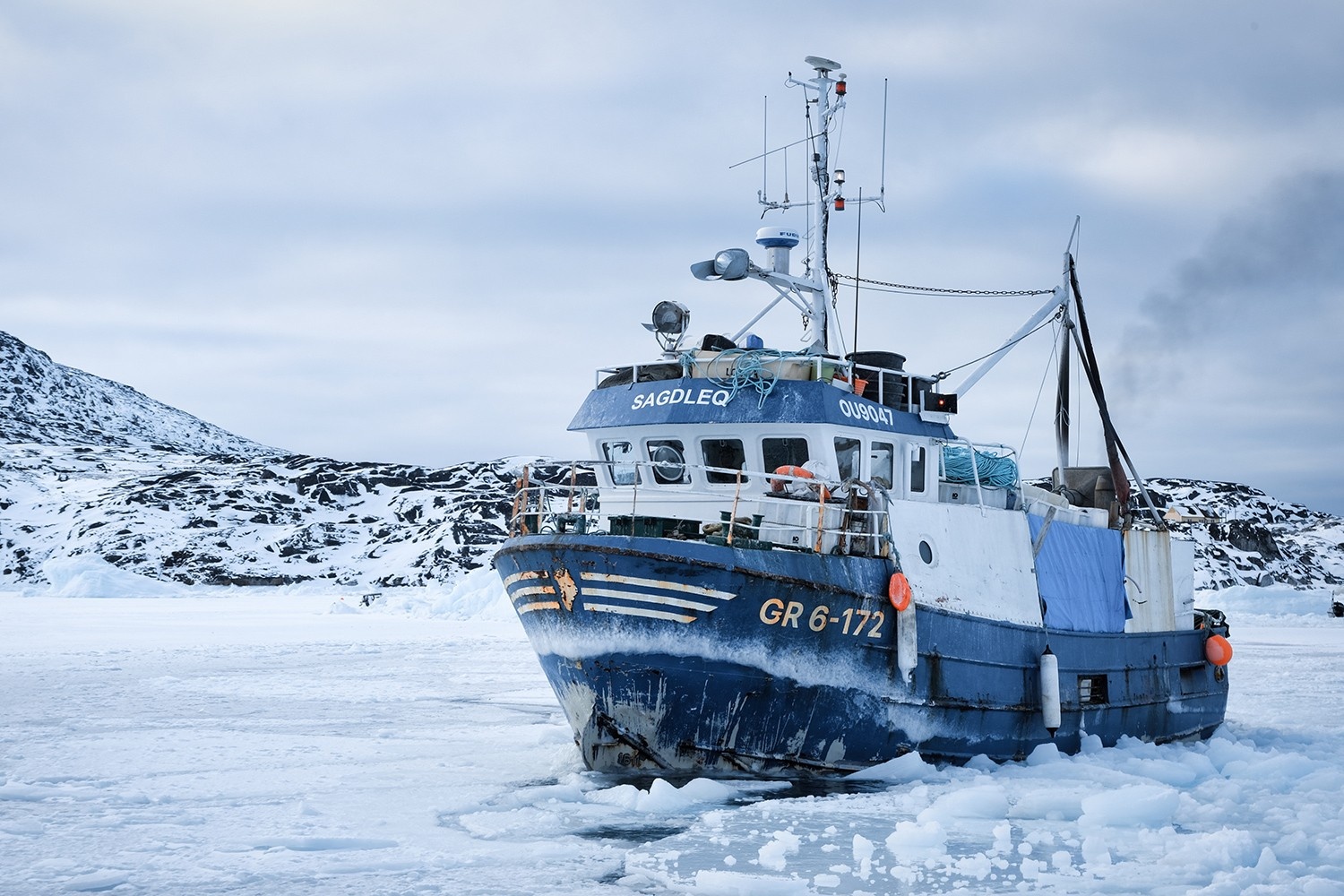
An ice breaker cuts a path. Courtesy of Joe Baur
Getting Past the Geopolitical Noise
Everyone’s talking about Greenland. Trump wants it for its coveted minerals and strategic location. Denmark wants to keep it (until Greenland votes otherwise). And scientists are rushing to study it to understand just how bad the climate situation is.
Greenland is a rising star on the tourism stage too, with visitor numbers climbing to record highs and a new airport opening up travel to the southern fjords. The question on many minds is whether Greenland becomes the next Iceland – overrun by tourism, with significant consequences for fragile ecosystems and compact communities.
What’s harder to find in the coverage is the place itself: the food, the landscapes, and the people living here, navigating between reclaiming their traditions and fielding unwanted global attention.
I spent a week trying to find that Greenland.
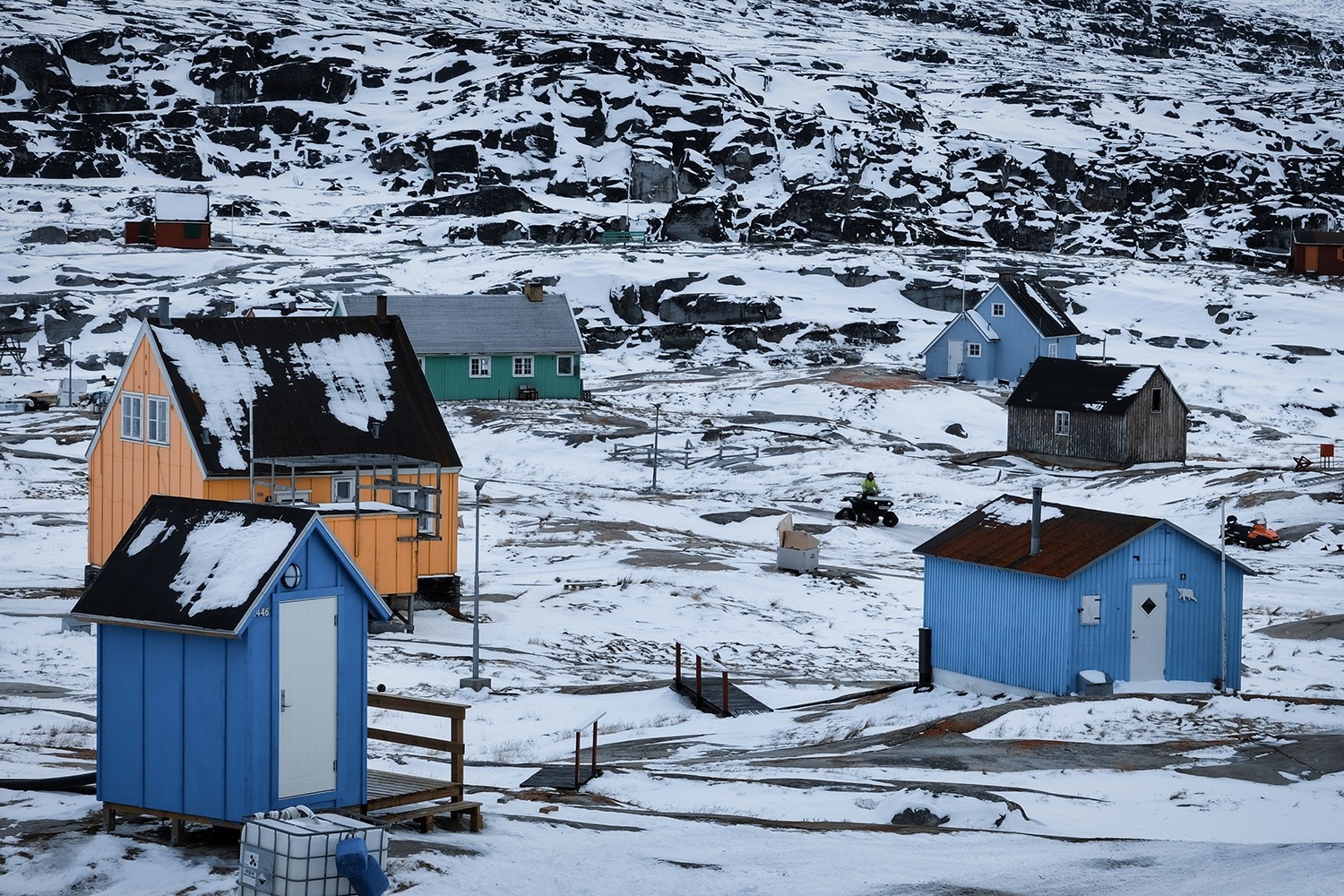
The settlement of Oqaatsut. Courtesy of Joe Baur
Exploring Icefjords and Isolated Towns in Greeland
It begins in Kangerlussuaq, an outpost of roughly 400 people founded by the U.S. Air Force in 1941. Guides here jokingly call it an American town, though the U.S. largely departed after the Cold War, donating much of what they’d built back to the community. They sold it for a dollar.
From Kangerlussuaq, a puddle jumper carries me over a landscape so vast and empty it feels like another planet – tundra giving way to ice, nothing below but the occasional frozen river catching the light. Forty minutes later, I’m in Ilulissat, Greenland’s third-largest city, famous for its colorful cabins and proximity to the UNESCO-recognized Ilulissat Icefjord.
An icefjord visit with Albatros Arctic Circle, a local tour operator, comes first – an hour out across calm water, surrounded by icebergs the size of apartment buildings calved from one of the world’s most active glaciers. When the cold and wind gets to be too much, you can step inside the vessel to warm up and grab a coffee. It’s a remarkably civilized way to witness something so geologically violent.
The next morning, we boarded the same type of boat for the journey to Oqaatsut, a settlement of roughly 30 people further up the coast. Reaching this remote town requires waiting for a fisherman’s boat to break through the ice ahead of us, the hull lurching and grinding before we can finish the final approach into the harbor.
Oqaatsut is the kind of place Denmark spent decades trying to empty, relocating Greenlanders into larger towns on the island and on the mainland. The most brutal example came in 1953, when U.S. and Danish authorities gave over 100 Inughuit people just days to pack up and leave their ancestral home in the Thule area, uprooting a millennia-old hunting culture to make way for the expansion of what is now Pituffik Space Base. They were resettled in Qaanaaq, further north, with no say in the matter.
Now, both countries are invested in keeping remote communities like Oqaatsut alive, partly through tourism.
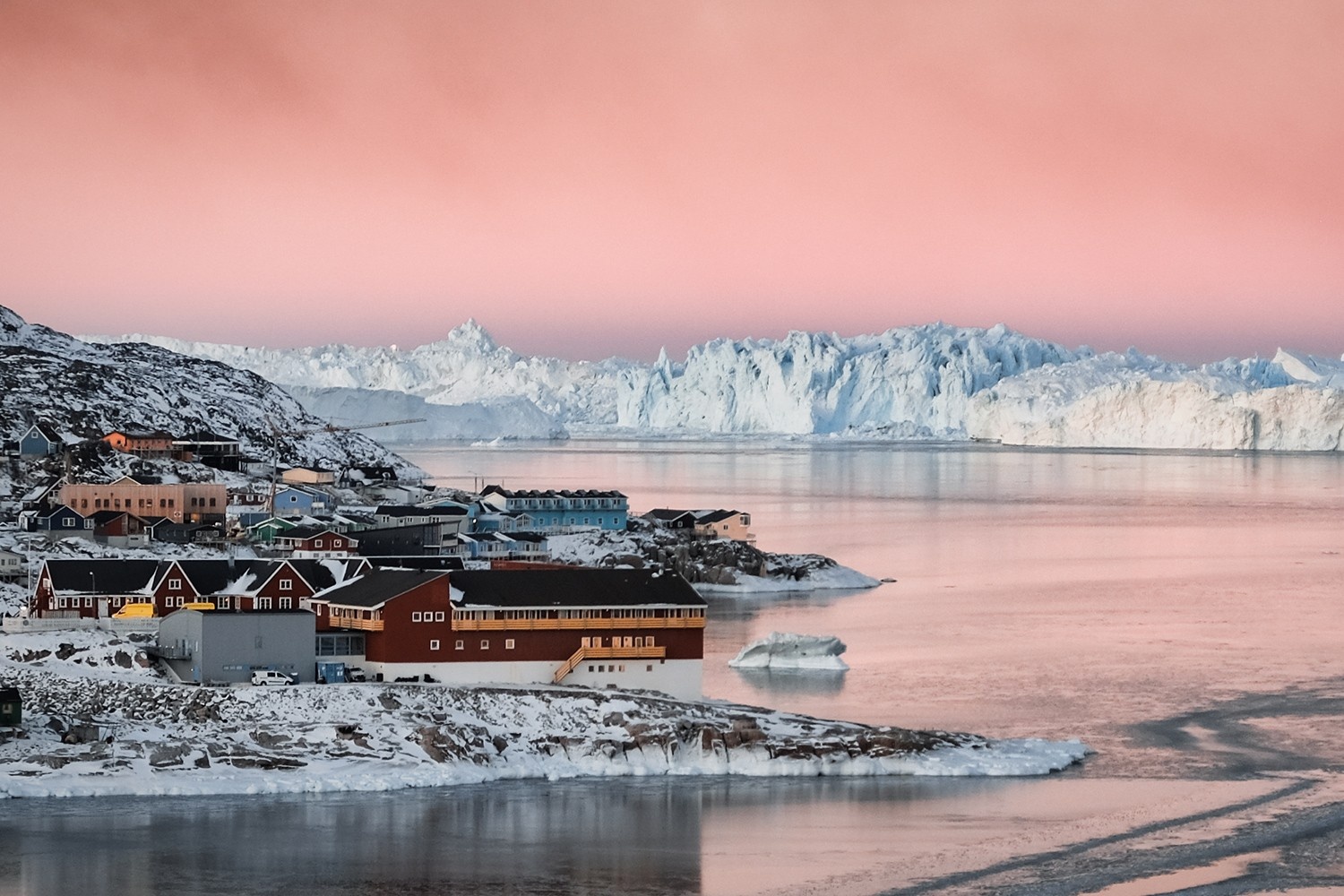
Ilulissat against a pink sky. Courtesy of Joe Baur
Meeting Greenlanders on Their Own Terms
Back in Ilulissat, a Diskobay Tours guide named Henni leads me through Sermermiut, a UNESCO-designated valley adjacent to Disko Bay where over 4,000 years of Inuit history can be traced. She was born and raised here, and she has thoughts about the international attention.
She calls Trump “the orange man,” a big crybaby who’s going to throw a tantrum when he can’t get what he wants, she says. The Greenlandic people are tough, she says. They’ve been adapting to nature for hundreds of years and they’re not afraid of him.
But she prefers to talk about something else.
“Under the headlines, we have the people who live in Greenland and survive the harsh winters and very, very hard summers,” she says. “It’s just the closeness that we have, we help each other out. Being warm to each other, being close. That’s very important to me and our culture.”
When I ask what she’d like foreigners to actually understand, her answer is simple: “I think the most important thing to remember is that we are humans. I know we look different, we have different traditions. We have feelings. We live here. We live by nature. I know there’s a lot of important people talking about Greenland, about minerals, about the stuff we have underground. But we are keeping them underground to survive up here.”
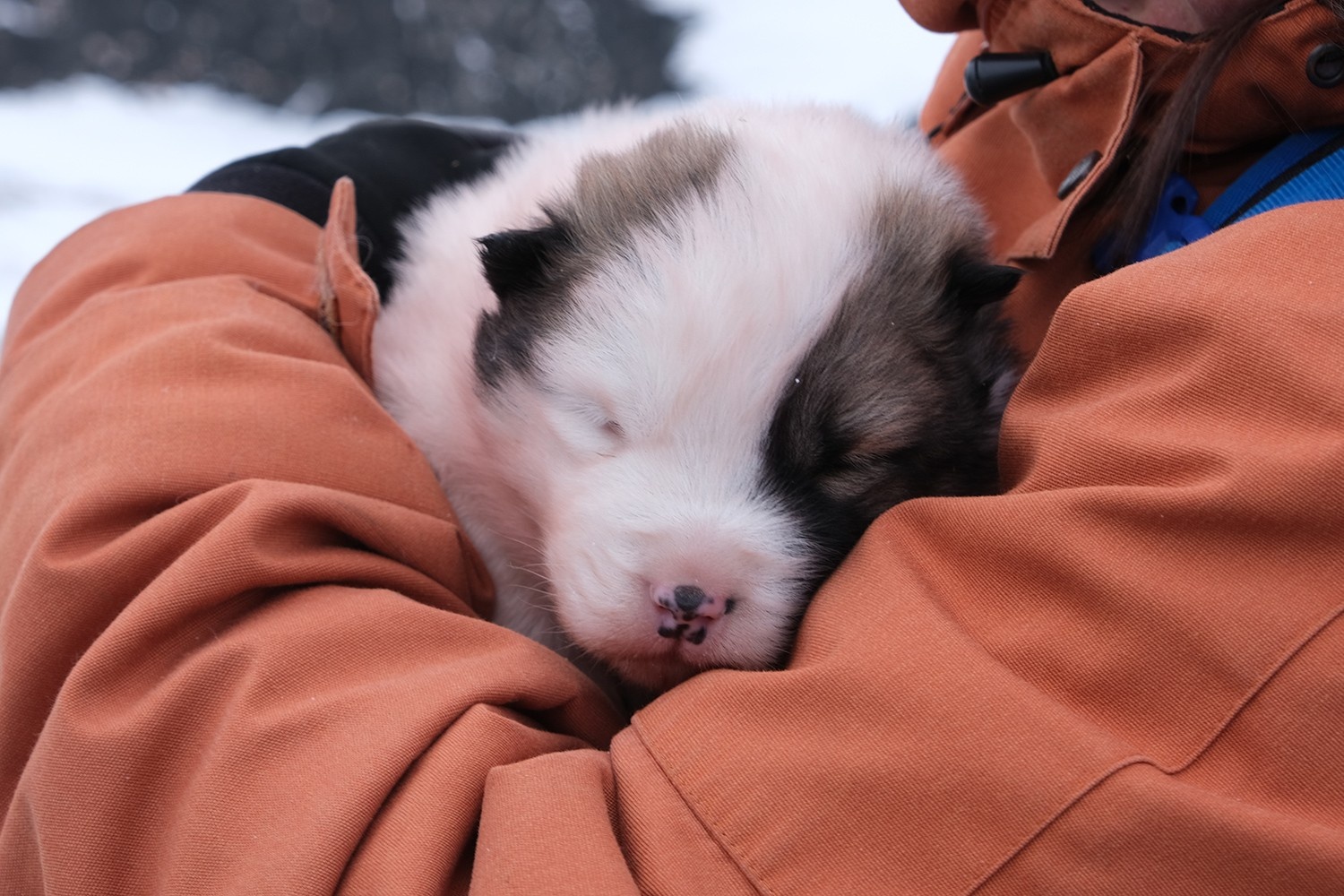
Meeting with sled dogs. Courtesy of Joe Baur
Cultural Loss and Reclamation in Greenland
Later, Nils – a Dane who left Copenhagen to work seasonally in Kangerlussuaq, drawn by what he calls the magnetic pull of the landscape – drives our group out across the tundra in a heavy-duty Arctic vehicle toward Russell Glacier. The behemoth presents as a 200-foot-tall face of ancient blue ice rising from the ground like a wall at the edge of the world.
“It allows me to think clearly,” he says of his adopted home. “That’s the reason I’m coming back here every season.”
It’s a sentiment that would resonate with Nivé, another local guide. We meet her in a wide open field outside Ilulissat with her dogs, waiting in that hard kind of cold that makes even standing still feel painful.
Nivé grew up in Nuuk but found herself in the strange position of learning about her own indigenous heritage from a German traveler. It was enough to encourage her to move her family north and start over, building what is now an extended family of more than 70 sled dogs and a tourism practice focused on cultural reclamation.
I asked her if there was a moment when she felt she had gotten her culture back.
“The first time I took six dogs out, driving out here, alone,” she says. “I had the biggest feeling of freedom I ever felt. And I felt my ancestors were there on the sled with me.”
This is the Greenland that escapes the headlines and the reason conscientious tourism here matters. Not as an abstraction, but because people like Nivé and Henni are actively using it to keep remote communities and living traditions intact. The most meaningful thing a visitor can do is show up with curiosity and respect.
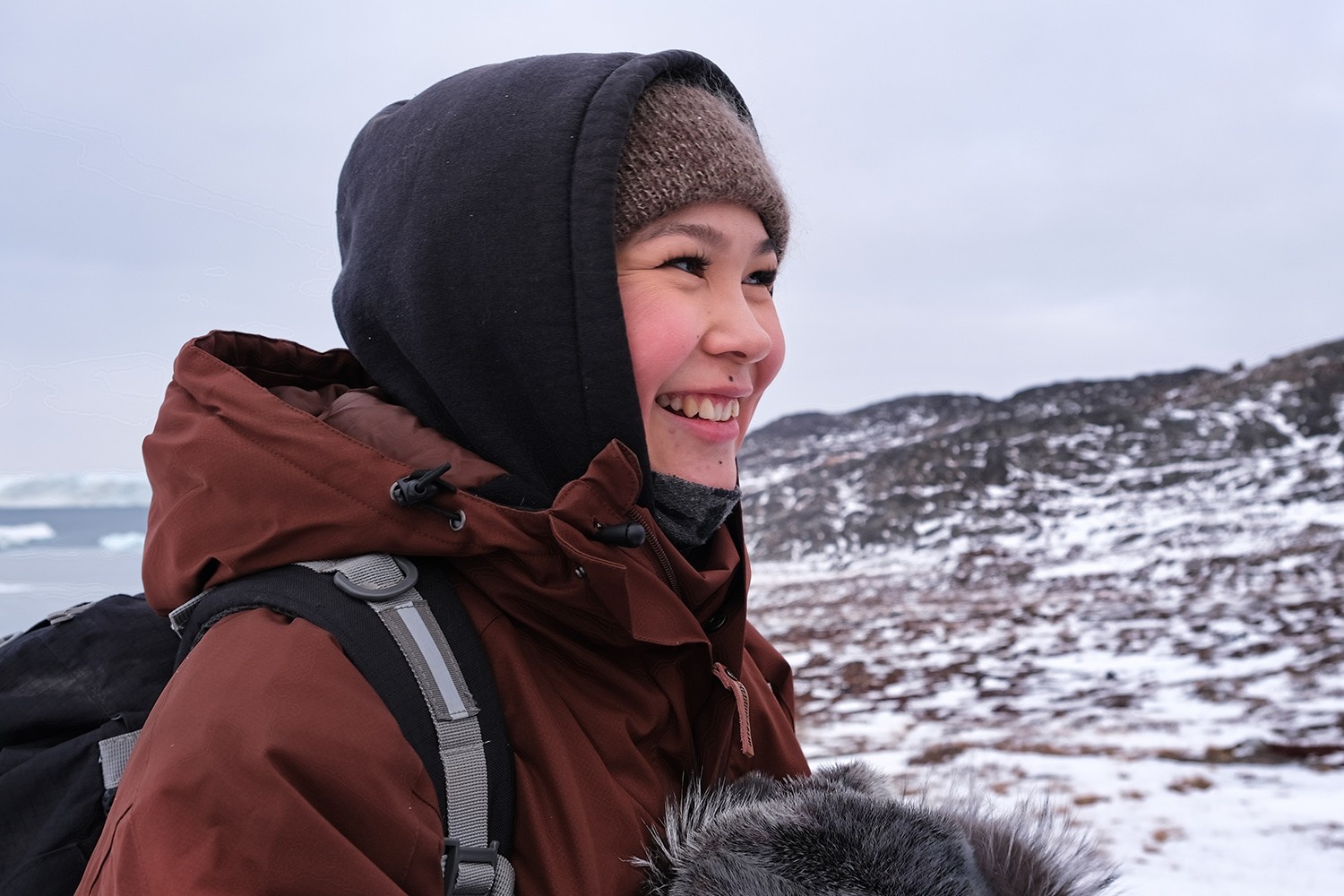
Guide Henni. Courtesy of Joe Baur
How to Visit Greenland
How to arrive: Most travelers connect through Copenhagen or Reykjavik into Kangerlussuaq or Ilulissat. There are also direct flights via Newark Liberty International Airport (EWR). Internal flights with Air Greenland link the major settlements.
Tour operators: Albatros Arctic Circle runs responsible tourism experiences – dog sledding, snowshoeing, ice fishing – in partnership with local communities like Ilulissat, Kangerlussuaq, and Oqaatsut. Diskobay Tours is a locally owned operator running guided experiences in Ilulissat and the nearby settlement of Ilimanaq: city walks, Sermermiut hikes, and dog sledding with local guides.
Where to Stay: In Ilulissat, Hotel Icefjord is the obvious base. It’s well-positioned for icefjord access and comfortable after a day in the cold. In Kangerlussuaq, Hotel Kangerlussuaq sits adjacent to the airport; you can be in your room 90 seconds after walking off the plane. It’s functional rather than atmospheric, which is all you could hope for in a town of 400 people that started as a military outpost.
Where to eat: The highlight is H8 in Oqaatsut, the remote 30-person settlement up the coast from Ilulissat. Named for the rooftop markings that the American military used to identify the building from the air during World War II, it’s now run as part of Albatros Arctic Circle’s community tourism operation. Don’t let the location fool you; the kitchen takes food seriously. The bean and lentil stew topped with mushrooms and pickled onions could hold its own anywhere.
Best time to visit: Spring (March–May) for dog sledding and northern lights with lengthening daylight; summer for the midnight sun and hiking. The ice cap is accessible year-round with a guide. Summer travel is great for longer hikes, midnight sun, and whale spotting with temperatures hitting as high as 50°F.
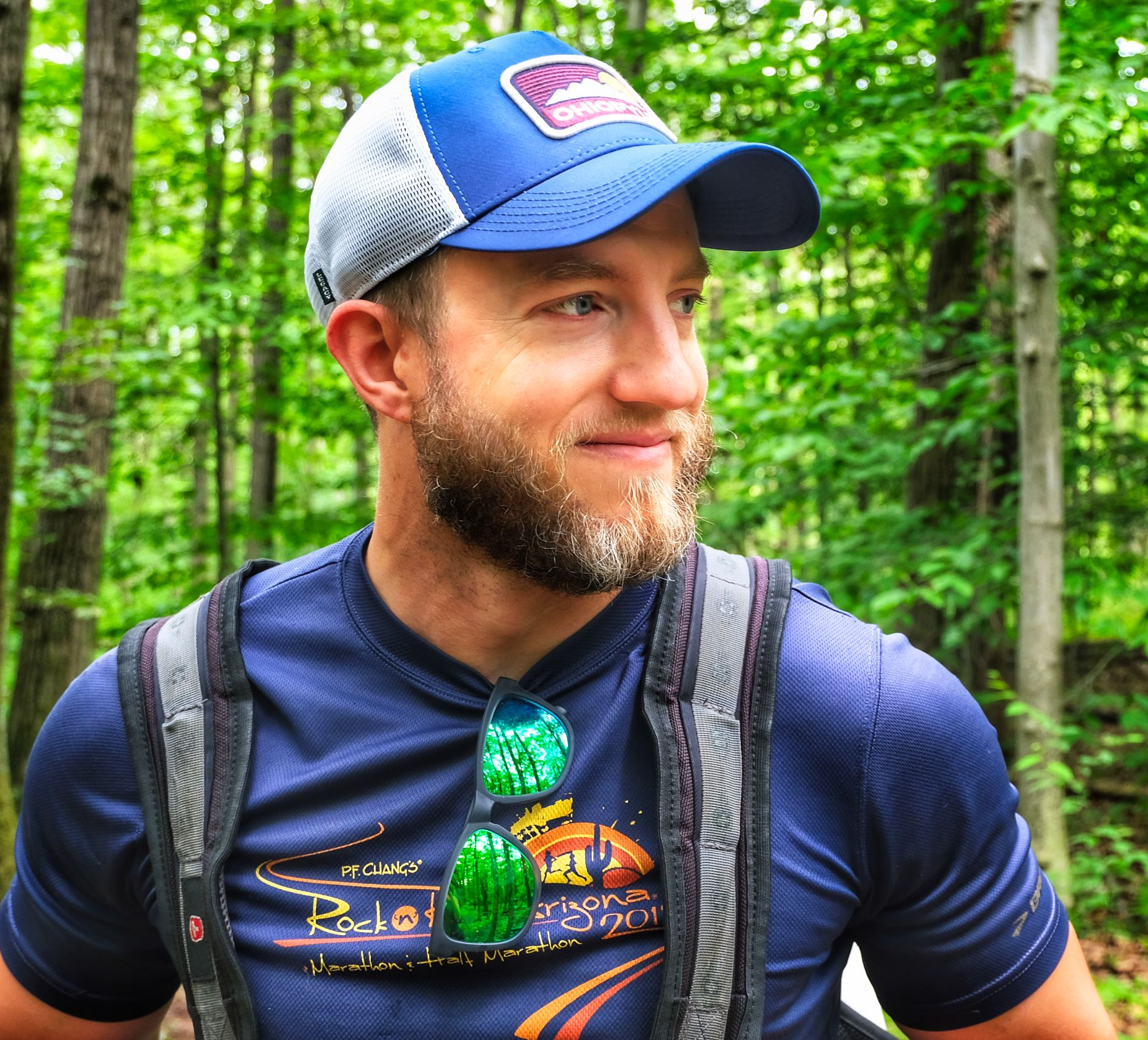
Joe Baur is a travel, food, and adventure writer/filmmaker born-and-raised just outside of Cleveland. These days he’s based in Berlin, hitting the trails across Europe and beyond as often as possible in search of stories and new ways to torture himself–all of which he documents on his YouTube channel. He can otherwise be found in Outside Magazine, BBC Travel, Saveur, National Geographic, and more. Find more of his work in his portfolio or follow Joe on IG @BaurJoe.
North Stars: Gender Equality, Production & Consumption, Wildlife Ecosystems