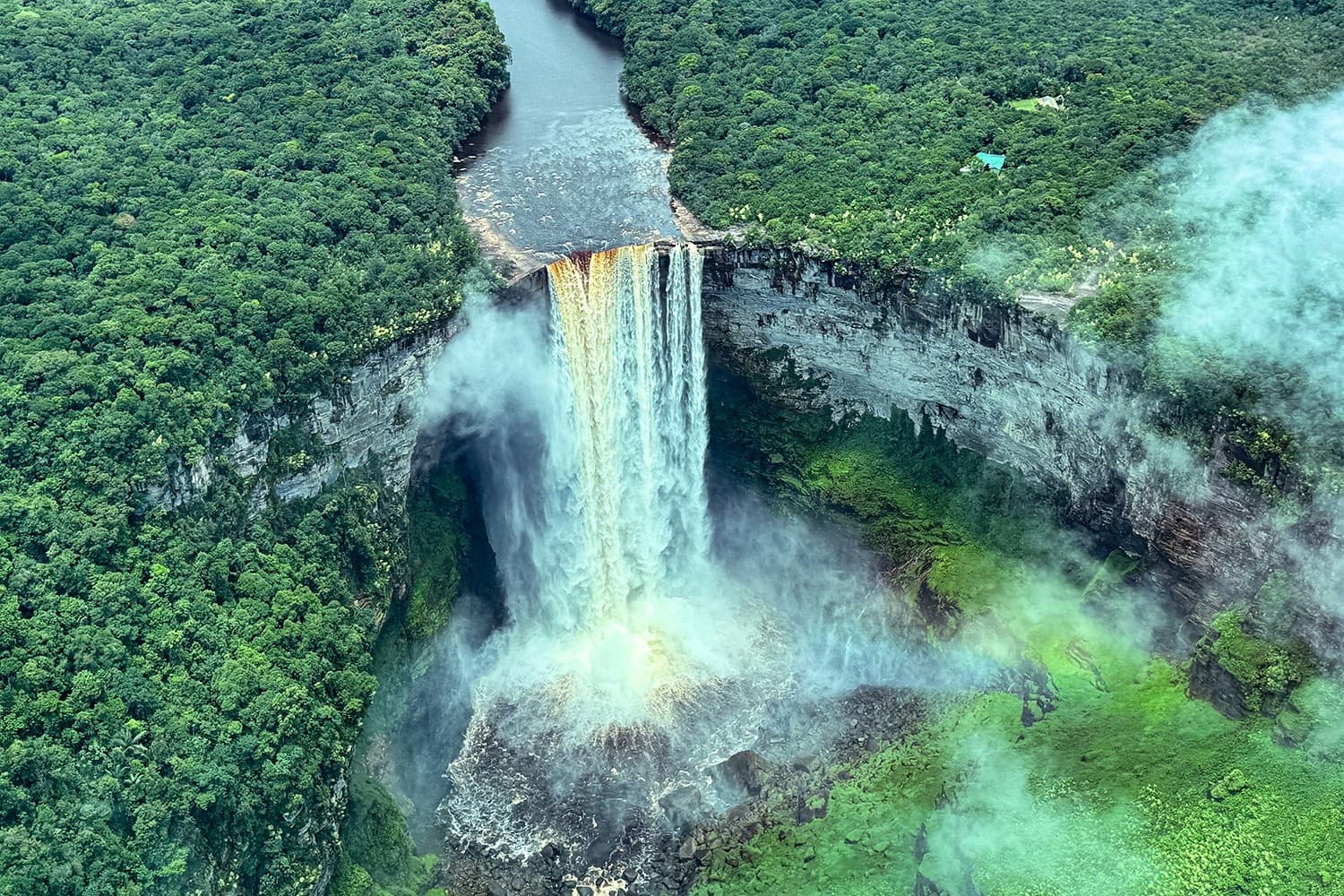
“As the land of many waters, naturally Guyana has some stellar waterfalls.”
The coarse hair of a capybara brushing against skin, the delicious smell of afternoon rain on the savannah, a chorus of cicadas at nightfall: Guyana takes hold of the senses and doesn’t let go.
For a long time, Guyana — a tiny country roughly the size of Idaho sandwiched between Venezuela, Brazil, Suriname, and the Atlantic on South America’s northern hump — wasn’t really on travelers’ radars. But that’s quickly changing. Thanks to the discovery of offshore oil in 2015, leading to a windfall of wealth, Guyana’s government has heavily invested in promoting the country as a premier ecotourism destination. It appears to be working; last year, the country received nearly 500,000 international visitors, its biggest number yet.
Guyana’s main draw is its nature. With ninety percent of the population clustered along the coast, the rest of the country stays sparsely populated, as untouched wild landscape. Thick rainforest blankets the interior; immense rivers cut through it (Guyana means “land of many waters”), and towering mountains preside over it all. Where humans have settled, like the coastal capital of Georgetown, cultural overload takes over. As a former British colony, all manner of global influences landed here from East Indian and Portuguese to Afrocaribbean, alongside indigenous Amerindian culture. It’s also the only English-speaking country in South America.
For those curious to explore this frontier adventure travel destination before word fully gets out, here are 10 reasons it’s worth a trip.
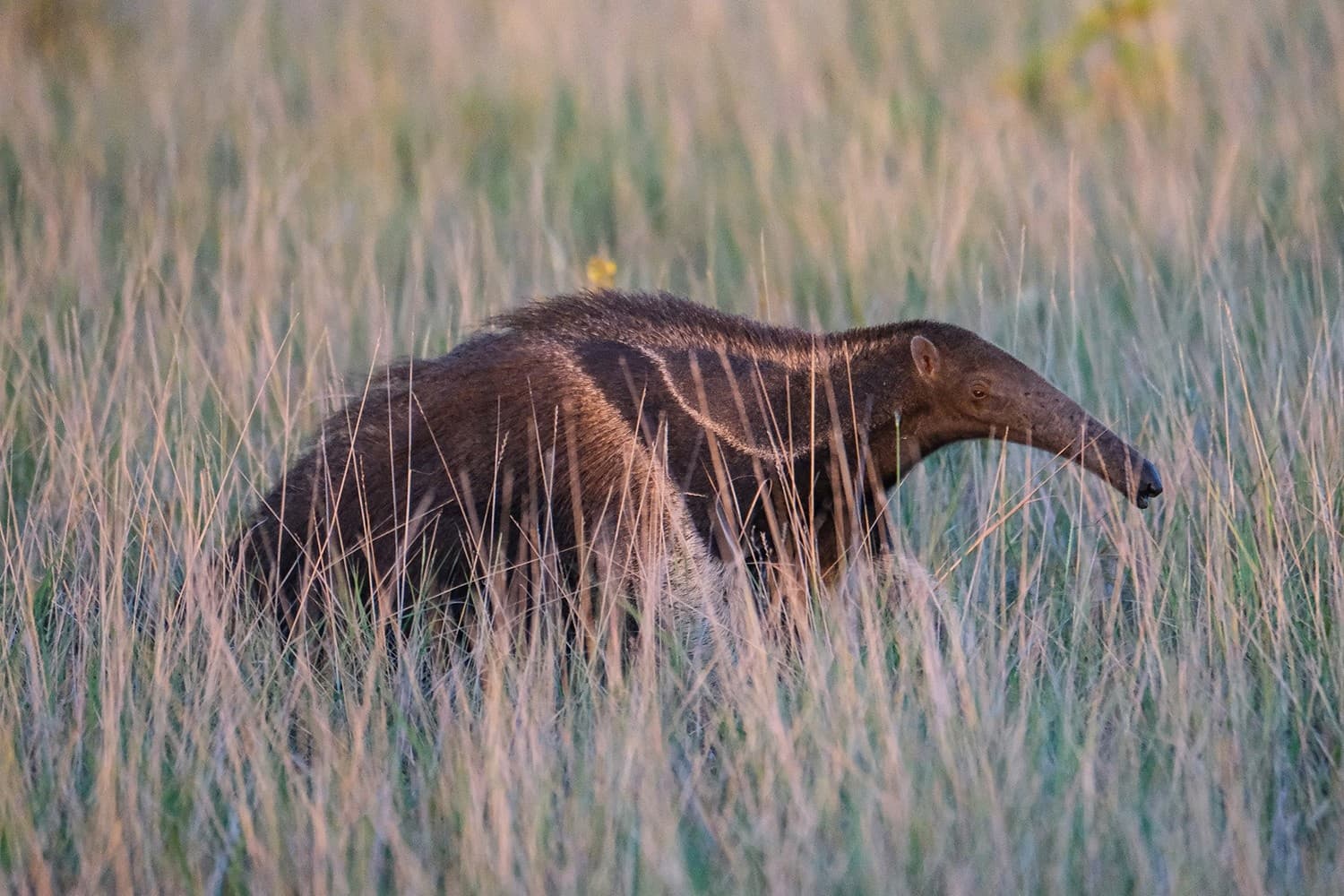
Giant anteater. Courtesy of David DiGregorio
1. It’s the Land of the Giants, Literally
Thanks to an outsized collection of some of the largest species on the planet, Guyana has earned itself the nickname of the Land of Giants. While sailing around the country’s many rivers and trekking through tropical rainforests and grasslands, travelers can spot giant anteaters, giant river otters, and immense harpy eagles, known as the flying wolf. Guyana is also home to the world’s biggest rodent, the capybara, giant arapaima fish, and the jaguar, the biggest cat in South America.
Some of these species, particularly the jaguar, can be hard to spot, but river cruises and rainforest expeditions nearly always come with some kind of wildlife sighting. Guyana has over 800 bird species, more than 200 mammal species, and hundreds more species in the fish, reptiles, and amphibians families.
2. Experience Indigenous Culture
Nine different Indigenous groups live throughout the country. Even before the tourist boom, many were offering community-run tourism experiences or stays at isolated Amerindian-owned lodges, making Guyana a continental leader in Indigenous and community-centered tourism.
Today, these peoples and villages continue to share their Amerindian heritage with outsiders, and tourist dollars help support cultural preservation and ecological conservation. Depending on the lodge and group, activities can include learning to make cassava bread or taking clay pottery or basket weaving classes. At the Caiman House in Yupukari, visitors can tag along on black caiman research expeditions or, at Rewa Eco-Lodge, go birdwatching or learn how locals catch giant freshwater fish like the arapaima.
3. Stay in Remote Ecolodges
With most of the population residing along the coast, accommodation options are few and far between in the rugged interior. But therein lies the appeal; staying at an isolated ecolodge like Rewa Eco-Lodge, Surama Ecolodge, or Iwokrama River Lodge is a classic Guyanese experience, requiring adventurous arrivals like boat rides or plane flights. Cities and towns feel miles away, nature pushes in on all sides, and the lodges are often Amerindian-owned-and-run.
Solar-powered and usually off-grid, the lodges generally offer all-inclusive-style stays with meals and activities included. Guests can stay in thatch-roofed benab huts or even sleep under the stars in swinging hammocks. Furnished with hand-carved wooden headboards and traditional woven baskets, each showcases the culture and artwork of its community.
Lodge owners often eat meals with guests, and guides from local villages share knowledge about flora and fauna on hikes and outdoor excursions.
4. Get On (or In) the Water
Guyana is the land of many waters, so partaking in the country’s vast network of rivers is essential. Canoe tours, boat rides, and other watery excursions are a common outing at lodges and hotels, with the chances to spot local wildlife along the way. The Rupununi River in southwestern Guyana is one of the best rivers for animal sightings, rewarding boaters with views of capuchin monkeys, baby otters, blue otters, and dozens of caiman.
There are also plenty of caiman-free areas and rivers for swimming, which can be especially nice as a way to cool off from the humid and hot weather. Check with guides for safe places to swim and splash around; for those exploring the Kanuku Mountains in the Rupununi region, Moco Moco Falls is a popular spot.
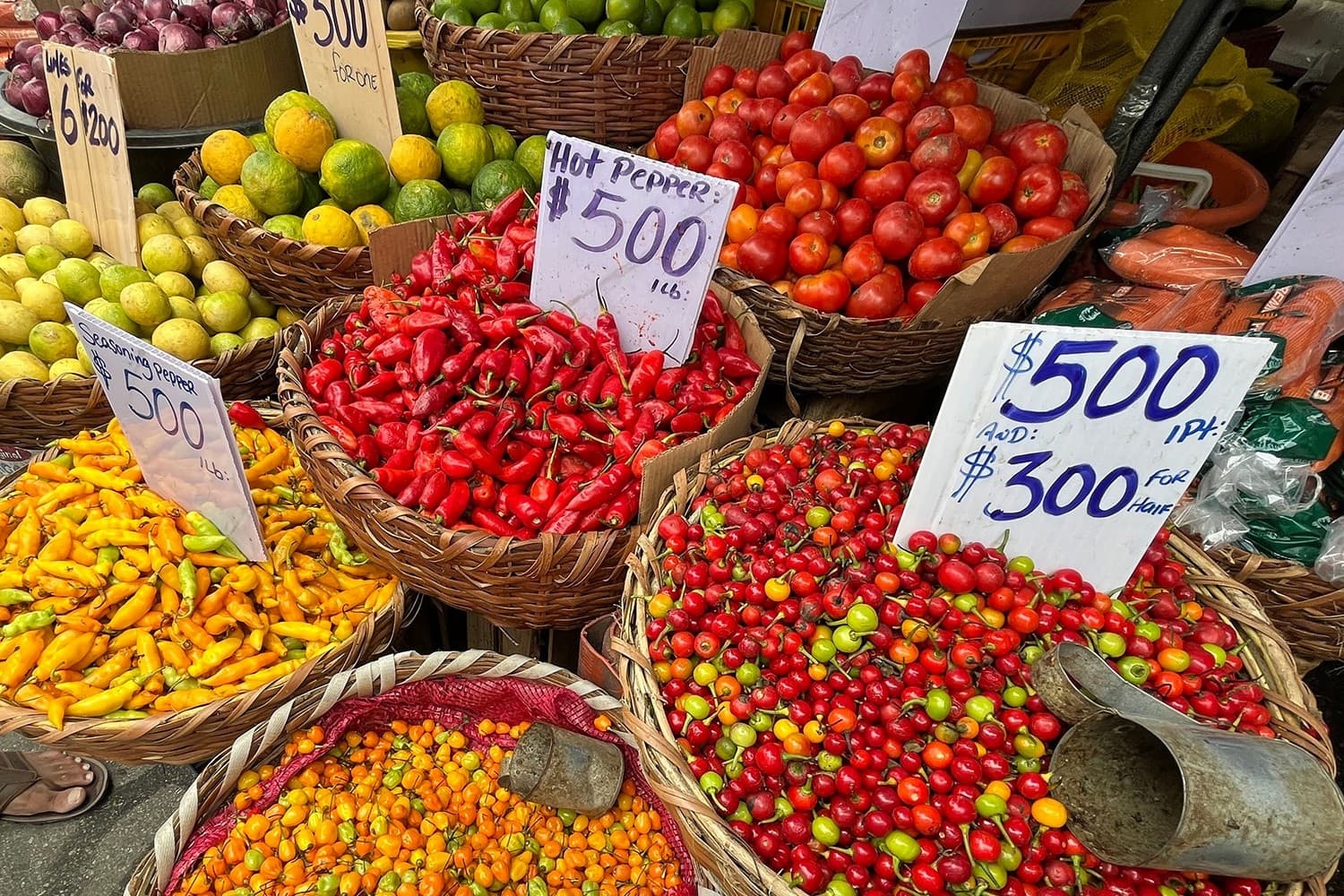
A produce market in Guyana. Courtesy of Kirsten Harrington
5. Savor Guyana’s Culinary Crossroads
The term “melting pot” is an apt descriptor for Guyanese cuisine. Thanks to the country’s colonial history and being part of the Guianas region, which was colonized by several major European powers, all manner of cuisines are found here, from Indian and African to Chinese and European. Feast on spicy curries with roti, flaky pineapple pastries, stir-fry dishes, pepper pot stew — the national dish — flavored with cinnamon and cassava, and a rainbow of tropical fruit. Guyanese rum, particularly the famous El Dorado brand, washes everything down.
Guyana is an especially noteworthy food destination thanks to the quality as well. As one of the few countries on Earth with a self-sufficient food supply, meaning all citizens can be fed without foreign imports, visitors can enjoy meals knowing practically everything has come locally from farms, fields, and the sea. This makes food markets a must-visit, especially the Victorian-esque Stabroek Market in Georgetown.
6. Explore the Rupununi Savannah
Located in southwestern Guyana and accessible via plane, the Rupununi Savannah spans 5,000 square miles of grassy plains, wetlands, and rolling hills. One of the most biodiverse parts of the country, here visitors can spot harpy eagles, giant anteaters, and jaguars on animal tracking safaris, birdwatching expeditions, and paddles along the Rupununi River. Striking landscapes of vast, wildlife-filled fields, fringed by the Kanuku Mountains, are another highlight, as well as the famed Termite City, where hundreds of termite mounds, some towering as high as eight feet, dot the ground like an alien village.
Along with Amerindian communities, the savannah is also home to Guyana’s cattle industry, giving visitors the chance to visit historic ranches and hang out with vaquero cowboys. Around Easter, the Rupununi Rodeo takes place, celebrating Amerindian ranch culture with lassoing, horseback rides, and other events.
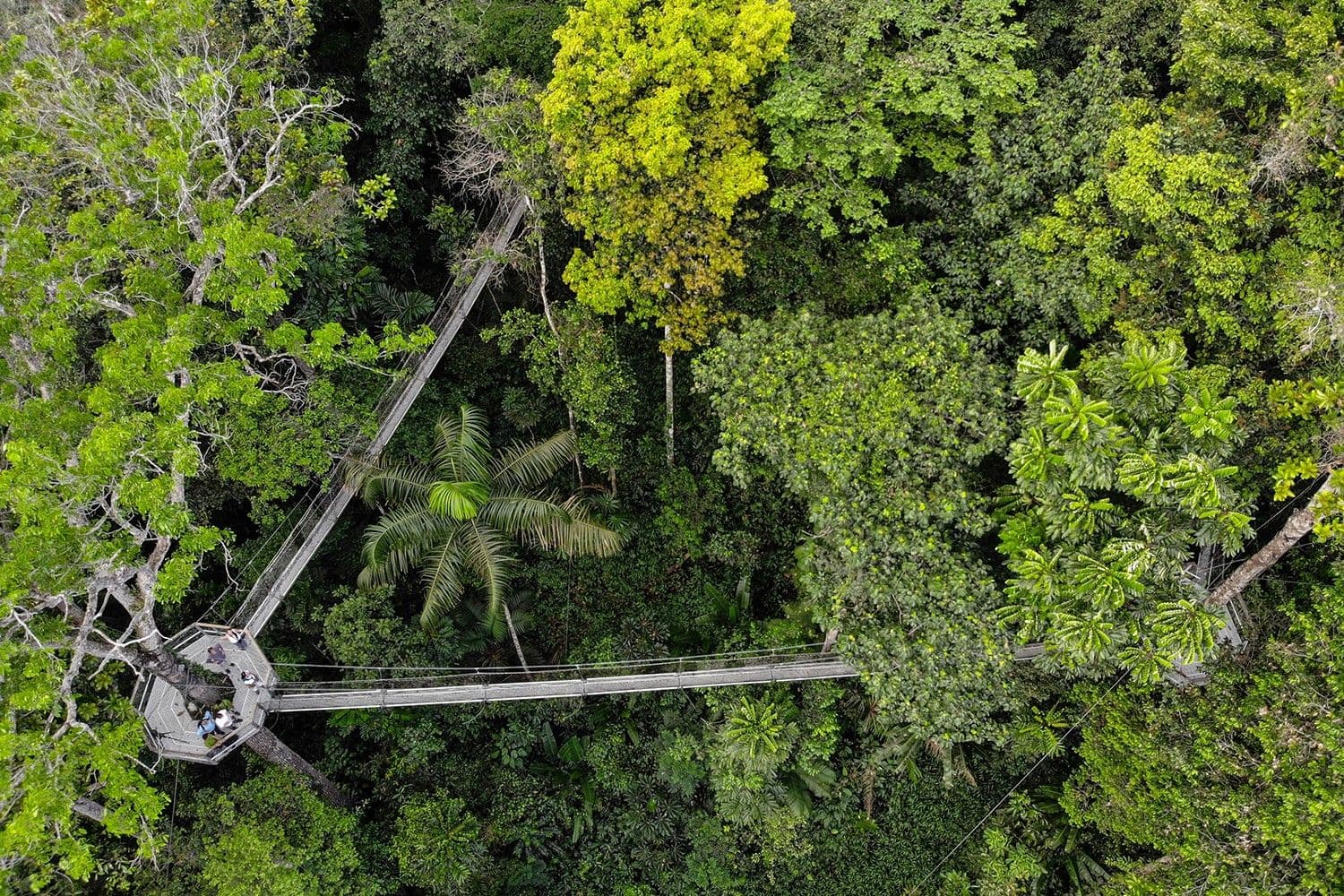
Rainforest canopy walk. Courtesy of David DiGregorio
7. Walk Among the Treetops of Iwokrama Rainforest
From semi-arid savannah, travelers move inland to Guyana’s dense rainforests, which cover over 90 percent of the land. Set in the center of the country, the Iwokrama Forest nature reserve is Guyana’s “Green Heart” where visitors get up close to the region’s flora and fauna at attractions and nature lodges. Strung through the treetops, the Iwokrama Canopy Walkway’s suspension bridges and viewing platforms allow for up-close admiring of scarlet macaws, toucans, and howler monkeys. The very lucky may even glimpse a jaguar down below.
At the nearby Iwokrama River Lodge, guests overnight in water-facing cabins on the banks of the Essequibo River, as well as learn about the reserve’s conservation work at the neighboring research center.
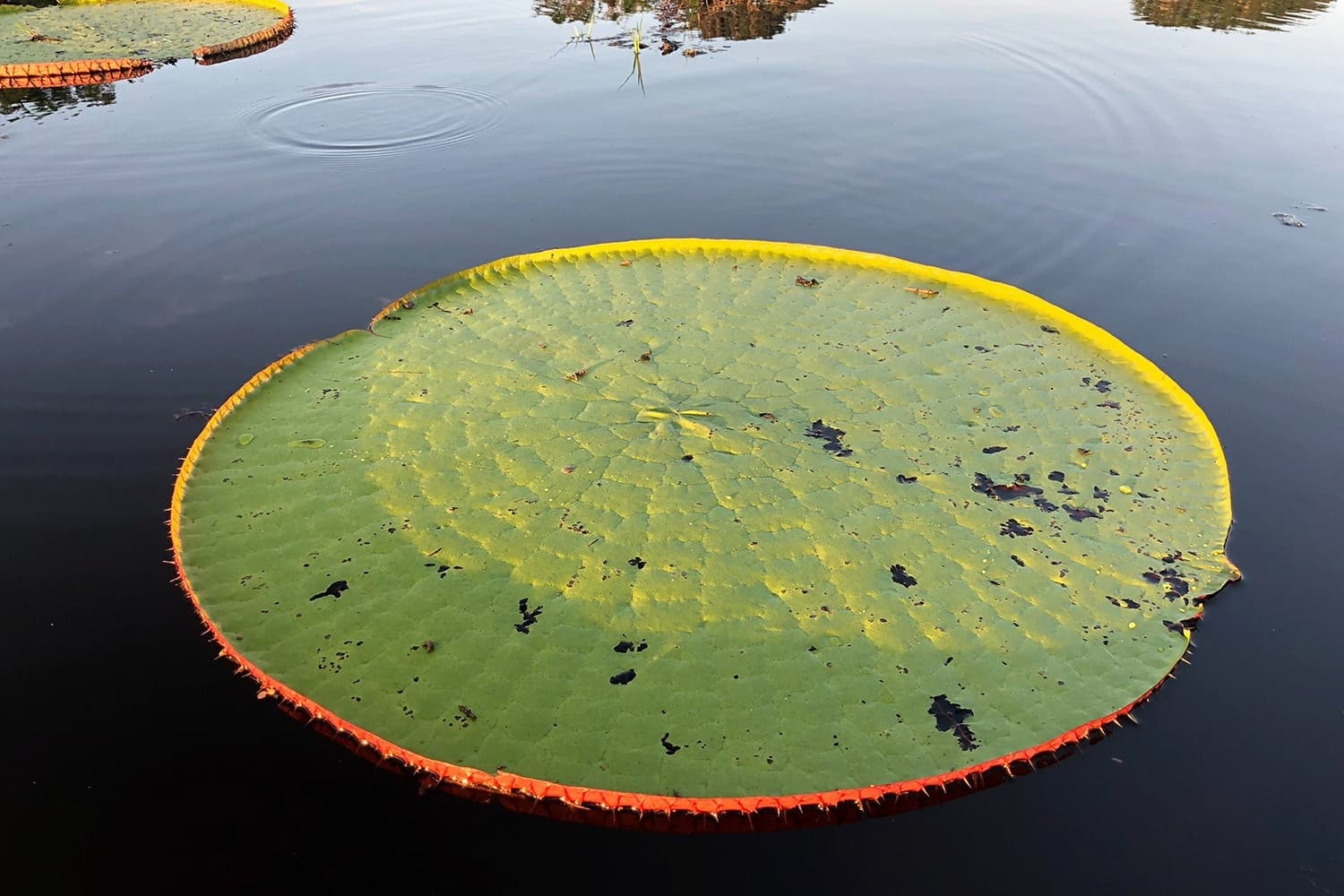
Victoria amazonica lilypad. Courtesy of David DiGregorio
8. See the Victoria Amazonica Waterlily
Animals aren’t the only things that are giant in Guyana. There’s also the Victoria Amazonica: Guyana’s national flower and the plant with the second-largest single leaf on Earth. A marvel to behold, this waterlily’s enormous, buoyant pads can grow up to 10 feet across and support the weight of a small child.
The Rupununi region is one of the best areas to admire these aquatic giants, which dot the surface of freshwater lakes and open up their tulip-shaped flowers when the temperature drops at night. The best time of day for viewing is at sunset, when the petals slowly unfold against a sunset-painted sky.
9. Stand Atop Kaieteur Falls
As the land of many waters, naturally Guyana has stellar waterfalls. Kaieteur Falls is one of the best; located in Kaieteur National Park, it’s one of the world’s largest and most powerful single-drop waterfalls. The torrential cascade plummets over a soaring cliff, with guided tours available to viewpoints next to the falls. The roar can be heard before the waterfall even comes into view, followed by standing on the cliff edge taking in the full spectacle. Look out for rainbows.
To prevent overtourism, crowd capacity controls are in place thanks to protective local villagers, which helps safeguard the ecosystem and visitor experience. Visiting the falls includes chances to see wild orchids, carnivorous plants, tank bromeliad plants, and endemic golden rocket frogs.
10. Gaze at the Stars
In the mostly undeveloped interior, barren landscapes and minimal light pollution have kept the night sky crystal clear, making stargazing a great pastime during ecolodge stays. Not only are the dark skies here especially pristine, but stargazers can also get views of both the northern and southern constellations thanks to Guyana’s position near the equator.
For the ultimate stargazing evening, sit back and watch the sunset with a rum punch in hand, lingering as darkness falls and the stars come out. Stargazing tours are sometimes available as well.

Kirsten Harrington is an Orlando, Florida freelance food and travel writer. Her work has appeared in Outdoors, Travel Awaits, Edible Orlando, The Beijinger, World Footprints, Time Out, BahamasAir Up & Away, Cacique inflight magazine and numerous other print and digital publications. Follow Kirsten on IG @wintergardenfoodie.
North Stars: Energy Efficiency, Heritage Value, Wildlife and Ecosystems
More Stories
 CULINARY, DRINK
Get to Know the Producers Behind the J.P. Bourgeois Portfolio
 CULINARY, DRINK
Where to Taste Wine in Willamette Valley
 DRINK
DRINKMeet the Distillery Making Vodka From Fog
 DRINK
DRINKSake’s Next Step: How Japan’s Rice Wine Is Evolving
 DRINK, HOME
The Buzz on InFizz: Breville’s Carbonator Elevates Sparkling Water