“We wanted to capture the essence of Newfoundland.”
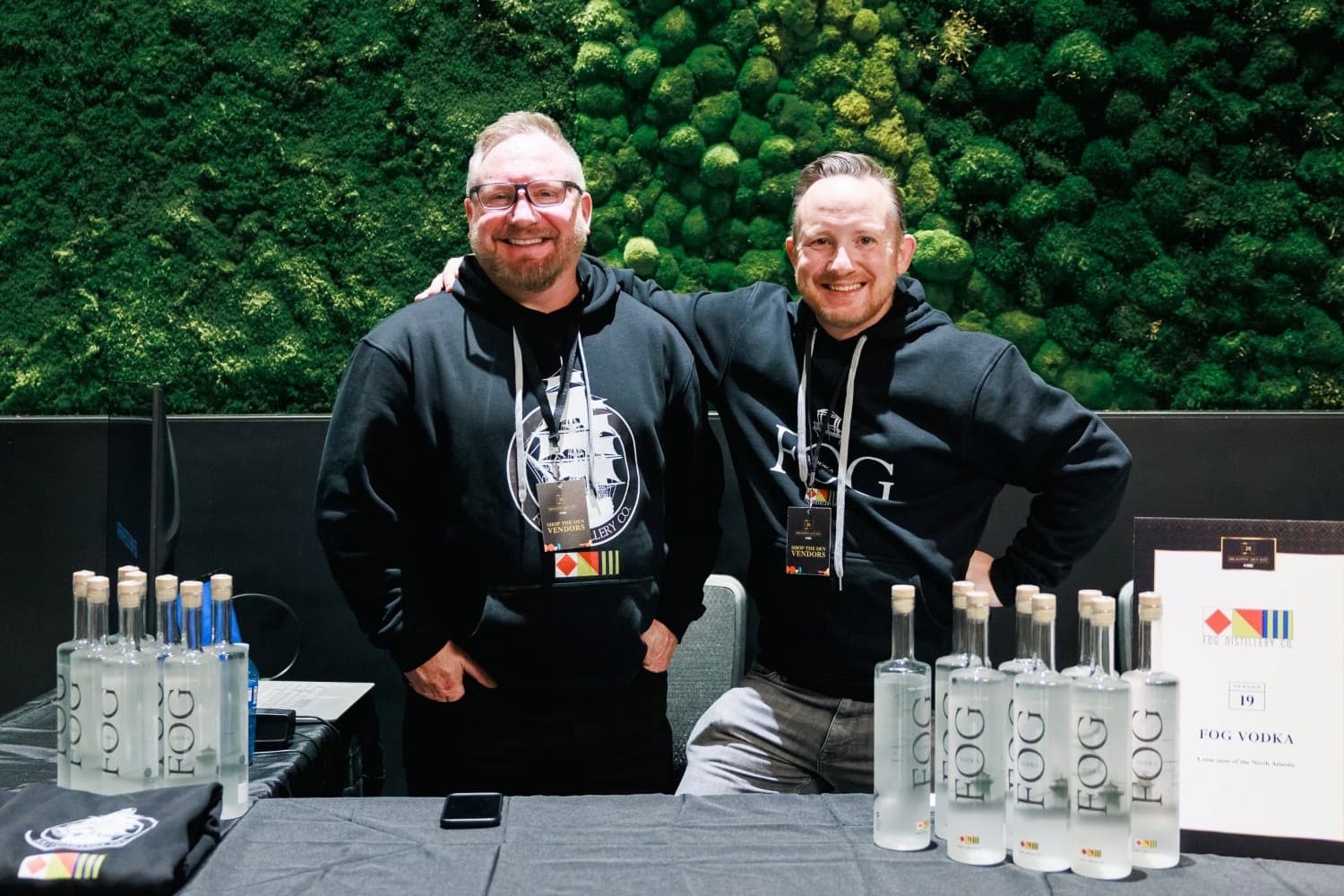
The founders in Calgary. Courtesy of Fog Distillery Co
Along the North Atlantic Coast of Canada’s Newfoundland and Labrador province, deep bays and fjords cut into rugged and rocky coastlines. In this region, the most easterly in North America – dense fogbanks are a common sight, pushed into shore by blustery winds. Fog is so prevalent here that parts of the island experience an average of 200 foggy days per year. Now, a local company has started harvesting the area’s famed fog to create a spirit with its own sense of place: fog vodka.
Based in Newfoundland, Fog Distillery Co. uses a system of fog capture nets to “harvest” fog, using the condensed water as the primary ingredient in its signature Fog Vodka. The company, founded by brothers Bill and Kenny Tuff, utilizes seven hydrophilic (water attracting) mesh nets, set up in the Marystown area of the island’s southeastern Burin Peninsula.
Looming above the craggy coast, the frame-supported nets, which consist of a mesh netting stretched between poles – look like black flags, standing in wait of the approaching fogbanks. Once the fog comes in contact with the netting, the water vapor condenses and turns to liquid droplets, which are collected for use. The process requires zero energy and snags water straight from the air.
“We’re collecting fog almost in its purest form,” says Bill. “Essentially, what we’re collecting is the salt crystals and minerals that are picked up by the North Atlantic.”
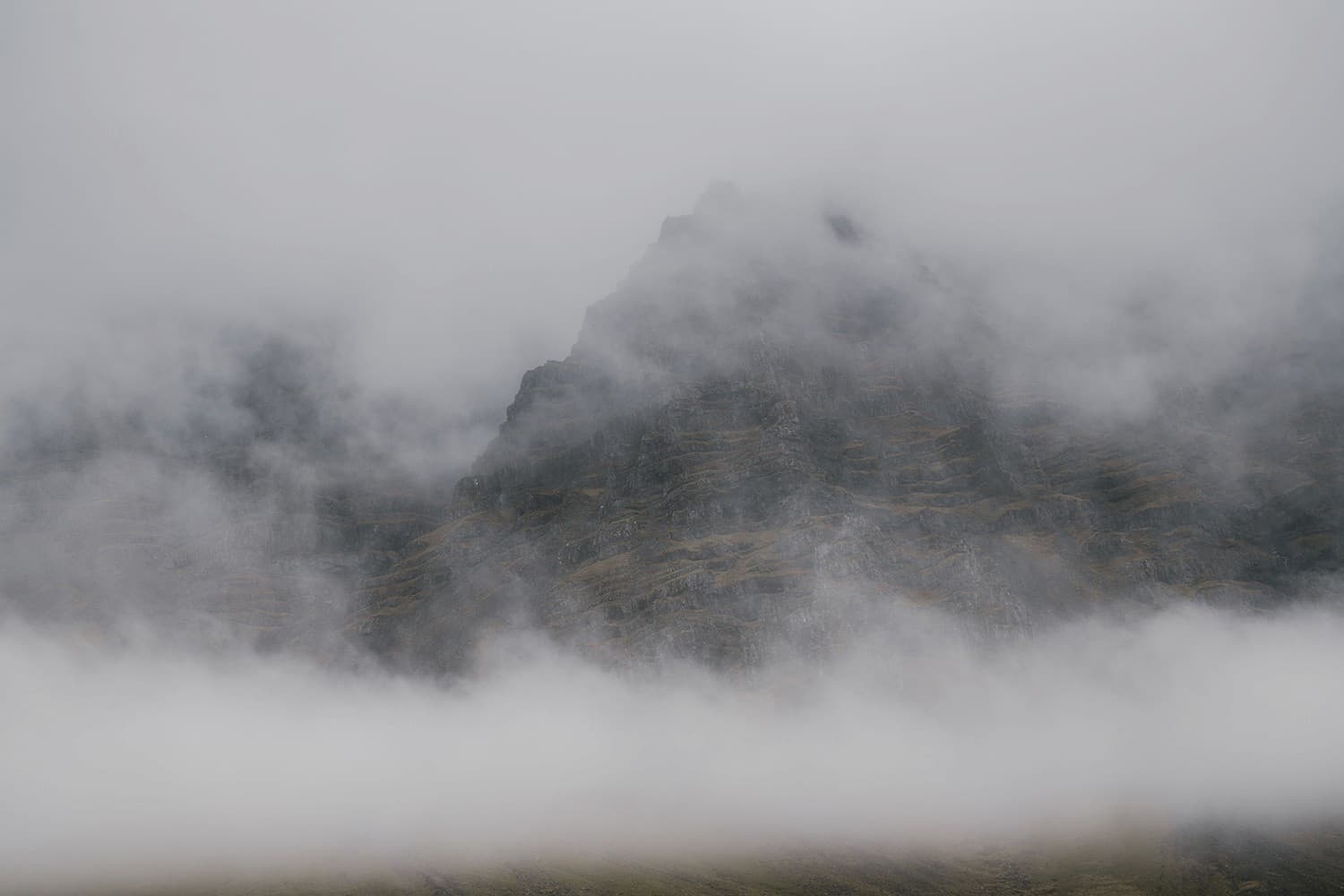
Foggy coastline. Courtesy of Pexels
Turning Air into Aqua
Harvesting water from fog is a process that’s been used in arid regions around the world for years as a means of securing fresh water. Early experiments began in South Africa and Chile’s Antofagasta mountain range in the late 1960s. Since then, fog collection systems have been deployed in locations as diverse as Guatemala, Morocco, Ethiopia, Nepal, and Eritrea. It’s even been used in alcohol production before, from a brewery in Chile to California’s Hangar One distillery, which released a limited-edition vodka made using water collected from NorCal fog.
It was from watching a documentary on the subject that Bill first learned about fog capture, leading to an idea to make use of Newfoundland’s abundant fog.
In order for the collection systems to function at the optimal level, very specific geographic and climatic conditions are required. “There are three very important elements that you need to make sure that you’re collecting fog adequately,” says Bill. “One, you need wind. That’s important for the agitation, moving the fog down the net, because if you don’t have wind, your nets are going to clog, and your water won’t fall or go into collection properly. You need hills. They help the fog move through the nets appropriately, and the third is you need fog. Newfoundland, fortunately, hits all three points just absolutely perfectly.”
Bill explains that fog needs to form around particulates in the air and in more heavily industrialized areas, such as near foggy metropolises including London or San Francisco, that particulate is often carbon from pollution. The Newfoundland fog, he says, forms around ocean elements, providing a more pristine water base to work with.
Currently, the company can collect over 60,000 liters (nearly 16,000 gallons) of water per year – much more than is currently needed for the distillery’s annual shipment of approximately 1,000 cases of vodka.
From Aqua to Alcohol
After collection, the water is then put through multiple stages of sediment filtration and treated before undergoing purity testing. Only then can it be turned into vodka, using a Canadian-produced ethanol derived from sweet corn.
“We found that added just a very slight sweet note to the end of our vodka” says Bill, noting that the honey-like sweetness pairs well with the mineral taste of the vodka itself, a flavor that Bill and Kenny says comes from the harvested, sea salt-laden fog water. It’s a flavor and style that’s earned the vodka recognition from the 2025 and 2026 World Vodka Awards, taking home multiple awards for its taste as well as label and bottle design.
The design, which comes courtesy of Kenny, is another ode to the distillery’s Newfoundland home and roots: a foggy-looking glass, through which a lighthouse, a tall ship, and maritime signal flags can be glimpsed. The nautical imagery was created to invoke both the province itself and the spirit of seafaring and coastal communities around the world.
“We wanted to capture the essence of Newfoundland, but we didn’t want it to be pigeon holed as a Newfoundland product. We wanted it to resonate globally for any coastal community, or even attract people inland to coastal life,” says Kenny.
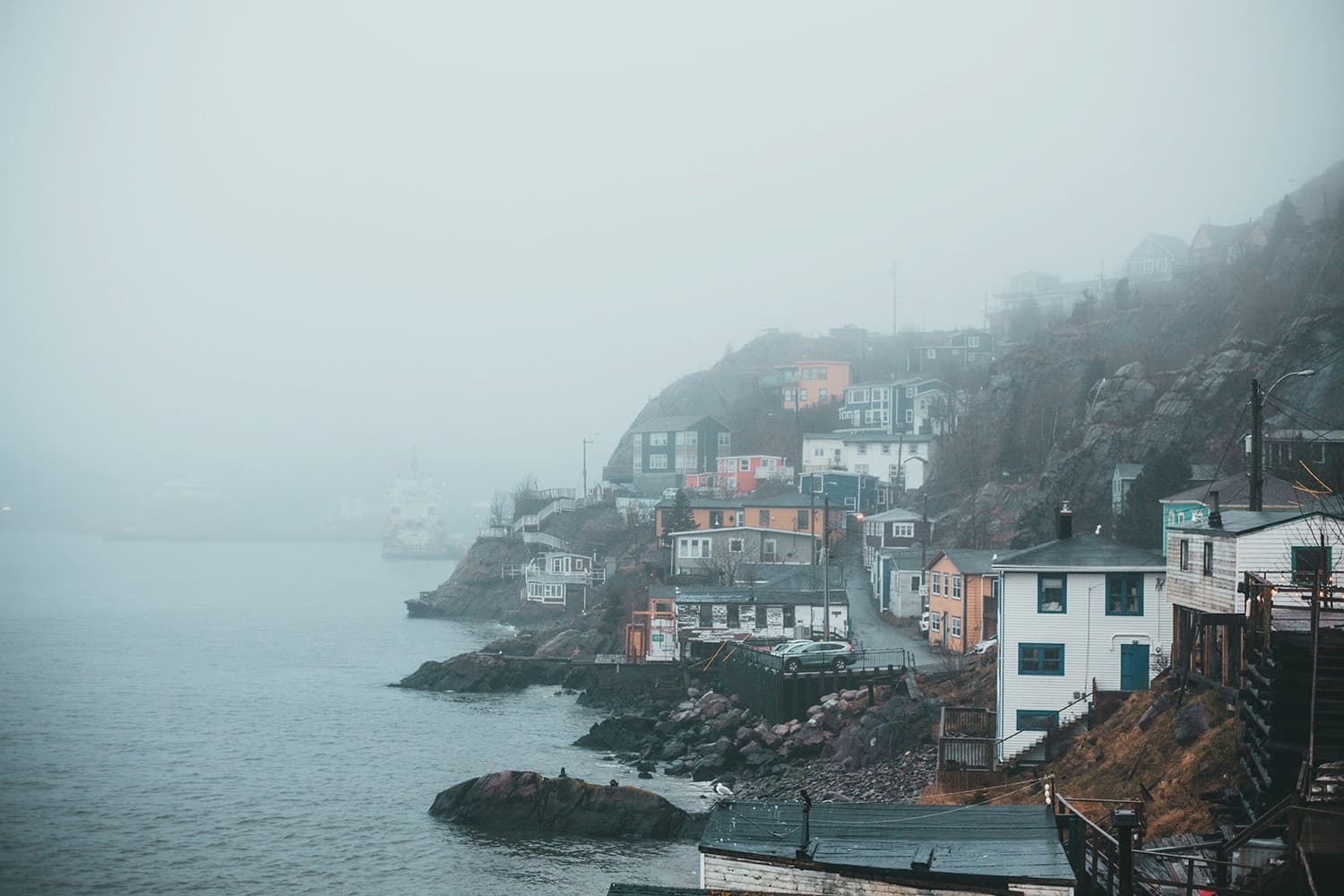
Coast of Newfoundland. Courtesy of Pexels
Bringing Fog Vodka to the World
As a small company that has only been in existence since fall 2022, Fog Distillery works with a co-packer to produce and bottle the alcohol, allowing the brothers to focus on fog collection and work toward scaling up production.
“Our business is that we’re water collectors. We’re water harvesters,” says Kenny, adding that other products, including a full line of spirits, are in the pipeline for expansion. If more water is needed, the company has additional nets that it can set up as well.
To date, Fog Vodka can only be found for purchase in the Newfoundland and Labrador province and select other areas around Canada including Alberta and Ontario. But the brothers say they want to see Fog Vodka develop into a global brand.
“We want to keep going forward, even if we’re a little slower to get off the ground and break those international barriers, but we feel that once we do, we’re going to be ready for it,” says Kenny.

Carolyn Gruske is an award-winning reporter and editor whose work has appeared in a wide variety of consumer and business publications throughout Canada and the United States.
North Stars: Energy Efficiency, Waste Management, Water Management
More Stories
 CULINARY, DRINK
Get to Know the Producers Behind the J.P. Bourgeois Portfolio
 CULINARY, DRINK
Where to Taste Wine in Willamette Valley
 DRINK
DRINKMeet the Distillery Making Vodka From Fog
 DRINK
DRINKSake’s Next Step: How Japan’s Rice Wine Is Evolving
 DRINK, HOME
The Buzz on InFizz: Breville’s Carbonator Elevates Sparkling Water