“We didn’t do this to sell vodka. We did this to promote Kernza.”
Grains make America go. From the economy — the United States is the biggest corn producer in the world, with 90 million acres planted, and millions more devoted to wheat — to cultural and culinary traditions like corn mazes, grains are a core part of American life.
But growing grain also comes at a hefty environmental price. Grain production occupies tremendous amounts of land and resources. Synthetic fertilizers degrade soil and can contaminate groundwater. Constant yearly replanting stresses ecosystems. Large-scale farming practices extract more and more from the land, diminishing its health. Alternating cash crops like wheat, corn, or soybeans with cover crops (an approach encouraged by the USDA to prevent soil erosion and nutrient runoff) is often cost-prohibitive for farmers. With prices mounting, farmers are under just as much strain as their fields.
Scientists and researchers have been searching for solutions, from engineered grains to introducing new options like fonio. One answer could be Kernza.
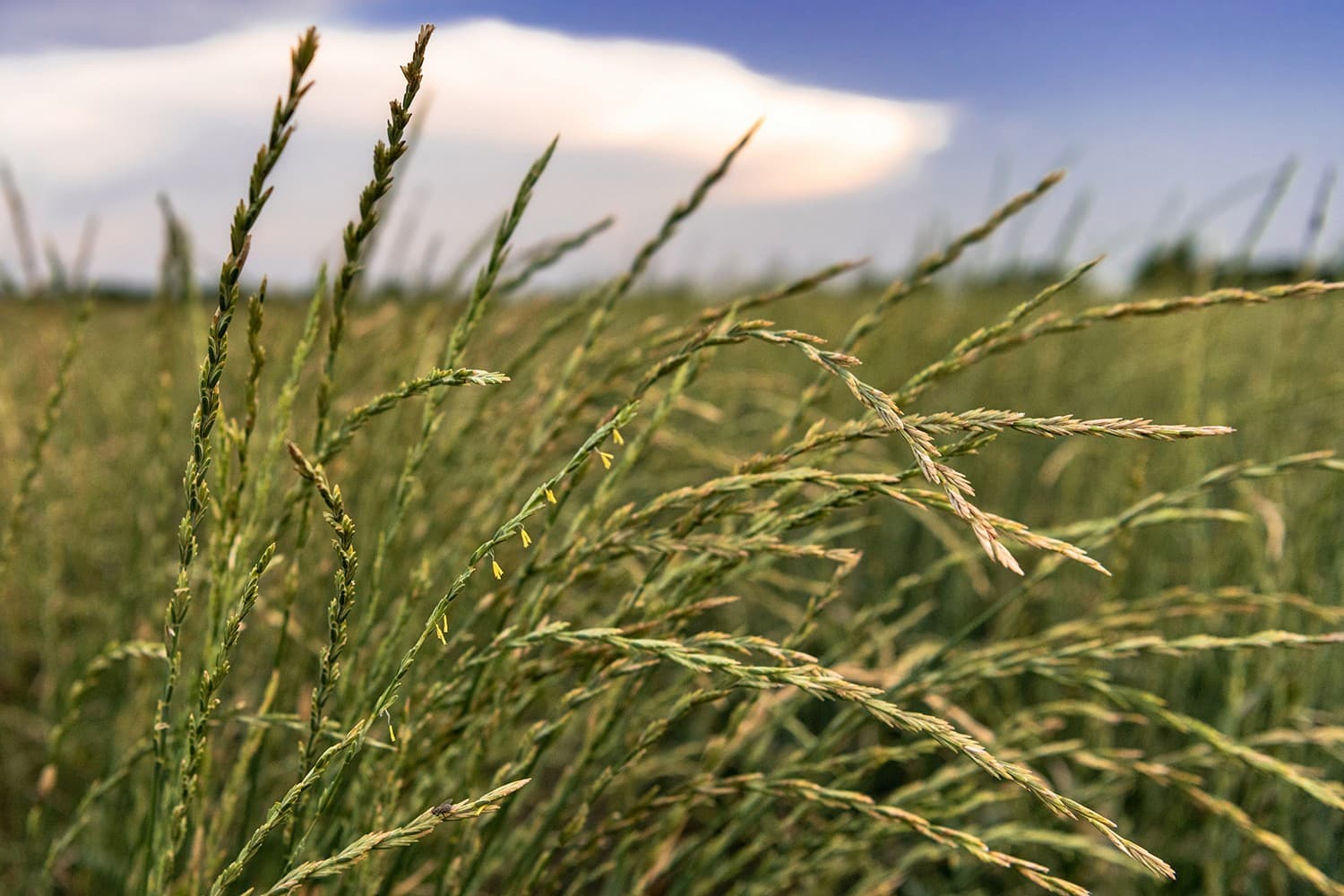
A close-up of Kernza grain. Courtesy of The Land Institute
Getting to Know Kernza
Derived from intermediate wheatgrass, Kernza is the first commercially available perennial grain in the world. Developed by The Land Institute, a Kansas-based nonprofit centered around sustainable agriculture, Kernza (a trademarked name blending ‘kernel’ and Kansas’ ‘Konza Prairie’) was developed to help tackle some of the issues facing agriculture today. The goal was to create a more climate-friendly grain that can pull double duty: feeding humanity and reducing agriculture’s ecological footprint.
While wheat requires annual replanting, Kernza’s perennial status allows it to grow back year after year without replanting. Doing so enables it to develop deeper root systems, reaching up to 10 feet below ground. This prevents soil erosion, sequesters carbon, filters nitrate contamination from groundwater, and improves soil health. Kernza also requires less fossil fuel and fertilizer, it functions as a cash crop and cover crop, and its ground cover provides habitat for pollinators and small wildlife.
“Kernza is a really key innovation to help farmers accomplish their conservation and sustainability goals,” says Dr. Mark Schlautman, a crop scientist and farmer who has been growing Kernza since 2018.
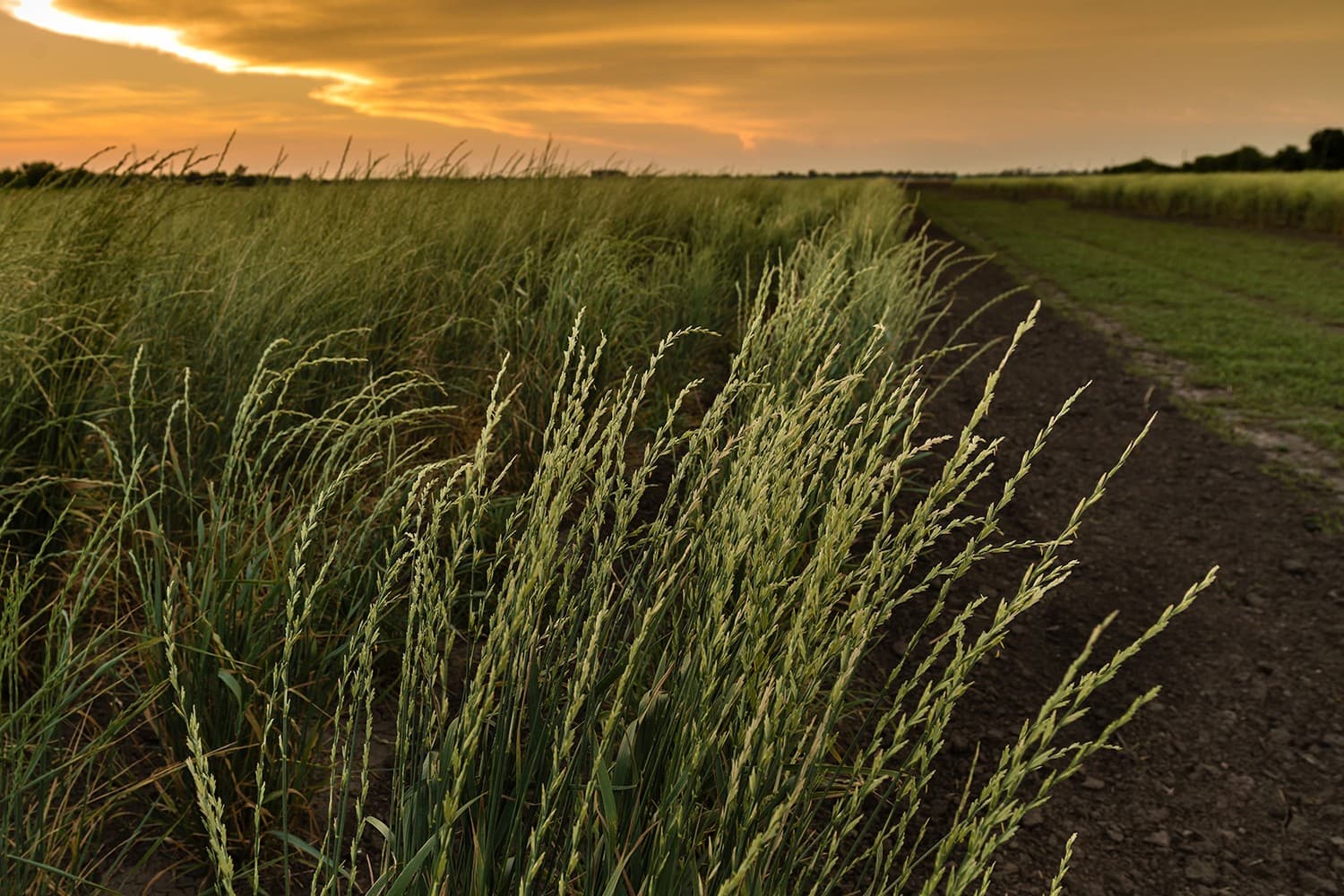
A field of Kernza. Courtesy of The Land Institute
Planting Seeds and Putting Down Roots
While wheat has been cultivated for some 10,000 years, Kernza is a relatively new crop. The first commercial variety was released in 2019. So far, it’s been planted on around 3,300 acres, mostly in Kansas, Minnesota, and Wisconsin, but with some spread into Montana, Oregon, Washington, and Michigan. Compared to the millions of acres devoted to traditional grain production, that’s small potatoes.
“Kernza has got a long way to go, but it is established and growing,” says Tammy Kimbler, chief communications officer for The Land Institute.
Kernza has the potential to offer huge economic and environmental benefits to farmers. However, there are roadblocks, like the challenges of building a grain-to-market pipeline from the ground up. “We have to create the whole system: milling, harvesting, processing, grading, [USDA crop] insurance,” says Kimbler. “The environmental benefits are the sticky, mission-driven part of the grain that I think will ultimately help repair communities and ecosystems.”
“I think it’s really important to recognize that almost all farmers want to spray [pesticides] less. They want to protect the environment,” says Dr. Schlautman. “Their whole occupation depends on soils and the natural resources that they’re using to grow food being available and ideally better next year than they were this year.”
There’s also the lack of existing market demand. “The reality is that the only way to really allow Kernza to be a solution for farmers is for there to be a demand pull, a market for the grain itself, in the U.S. food and beverage industry,” says Dr. Schlautman.
So, he created a solution: he co-founded a Kernza-only distillery.

A bottle of Kernza vodka. Courtesy of Perennial Spirits
Craft Spirits, Made With Kernza
Launched in 2025, Perennial Spirits is a Midwest-based distillery founded explicitly to help create demand and interest by showing off what Kernza could do. The distillery produces only one spirit, vodka, and it’s made from 100% Kernza grain sourced from farms in Kansas and Nebraska.
“We didn’t do this to sell vodka. We did this to promote Kernza,” says Beth Robertson-Martin, one of Perennial’s co-founders alongside Dr. Schlautman and Shawn Gruenhagen.
If the goal is to increase demand for Kernza, a distilled spirit is a uniquely efficient way to do so. To begin with, spirits have a much longer shelf life. They’re also a high-value product, so farmers can be fairly compensated. Most importantly, distilling requires a lot of grain. Robertson-Martin estimates Perennial Spirits uses 30,000 pounds of Kernza per year, making it one of the grain’s top buyers.
“It’s such an interesting vodka — it’s got so much more flavor [than other vodkas],” says Robertson-Martin. “You can use it in any cocktail that normally uses gin, or even cocktails that use bourbon. We’ve seen people do versions of Old Fashioneds with it.”
The vodka is distilled in small batches using a column still and lightly filtered to preserve Kernza’s slightly sweet, earthy flavor notes. Distilled at Silver Tree Spirits, a farmer-owned craft distillery in Paxton, Illinois, the spirit has been slowly spreading since its debut last year. Minnesota, a state famed for its grain industry with its own state grain, is ground zero for the growth, with numerous liquor stores, bars, and restaurants either selling it or offering it behind the bar. For example, at Spoon and Stable in Minneapolis, the spirit is regularly featured in daily cocktail specials, like a Vesper made with Perennial Spirits vodka, tomato water gin, orange wine, and a pickled tomato garnish. For those not in Minnesota, shipping is available to 44 states and, as the distillery isn’t open for tours, Perennial Spirits often hosts tasting events.

Kernza vodka can be used for all sorts of drinks. Courtesy of Perennial Spirits
Connecting More People With Kernza
Since the first two runs of vodka used grain that had already been planted, Perennial Spirits hasn’t increased Kernza acreage. However, the company is already increasing its footprint. A gin is in the works, and in August, the distillery barreled the world’s first single malt Kernza whiskey. Meanwhile, retail distribution is growing into additional states. All factors that could lead to more Kernza being planted.
“As a farmer, I want to plant more acres of Kernza next year than I had this year, and I really can’t,” says Dr. Schlautman. “The only way I can ever do that is for food and beverage companies to find success and bring Kernza-containing stuff to the public.”
Not unlike the perennial plant itself, building momentum for Kernza spirits will require a sustained, deep-rooted effort.
“You can get into a doom spiral with social media and the world today, thinking that no one cares,” says Robertson-Martin. “I do a lot of [Perennial Spirits] tastings, classes, and events, and everyone I talk to is excited about the story and the potential of this grain on the ecosystem and the farmers’ livelihoods. That gives me an incredible amount of hope.”

Stacy Brooks is a Minneapolis-based writer who has been covering food and travel since 2015. Her writing has appeared in over 35 publications, including Business Insider, Thrillist, Wine Enthusiast, and Midwest Living, and she wrote the Minnesota chapter of Fodor’s American Spirits. She blogs about food and travel at Tangled Up In Food and spirituality through a Jewish lens at Still Proofing. Follow her on Instagram at @_tangledupinfood.
North Stars: Carbon Footprint, Production and Consumption, Water Management
More Stories
 CULINARY, DRINK
Could This Distillery Help Change Agriculture?
 CULINARY, DRINK
Wine Regions on the Rise: Where to Sip Next
 CULINARY, DRINK
Get to Know the Producers Behind the J.P. Bourgeois Portfolio
 CULINARY, DRINK
Where to Taste Wine in Willamette Valley
 DRINK
Meet the Distillery Making Vodka From Fog