“For travelers, Tucson’s sustainability measures appear in daily details: public art, bike routes, and heritage architecture.”

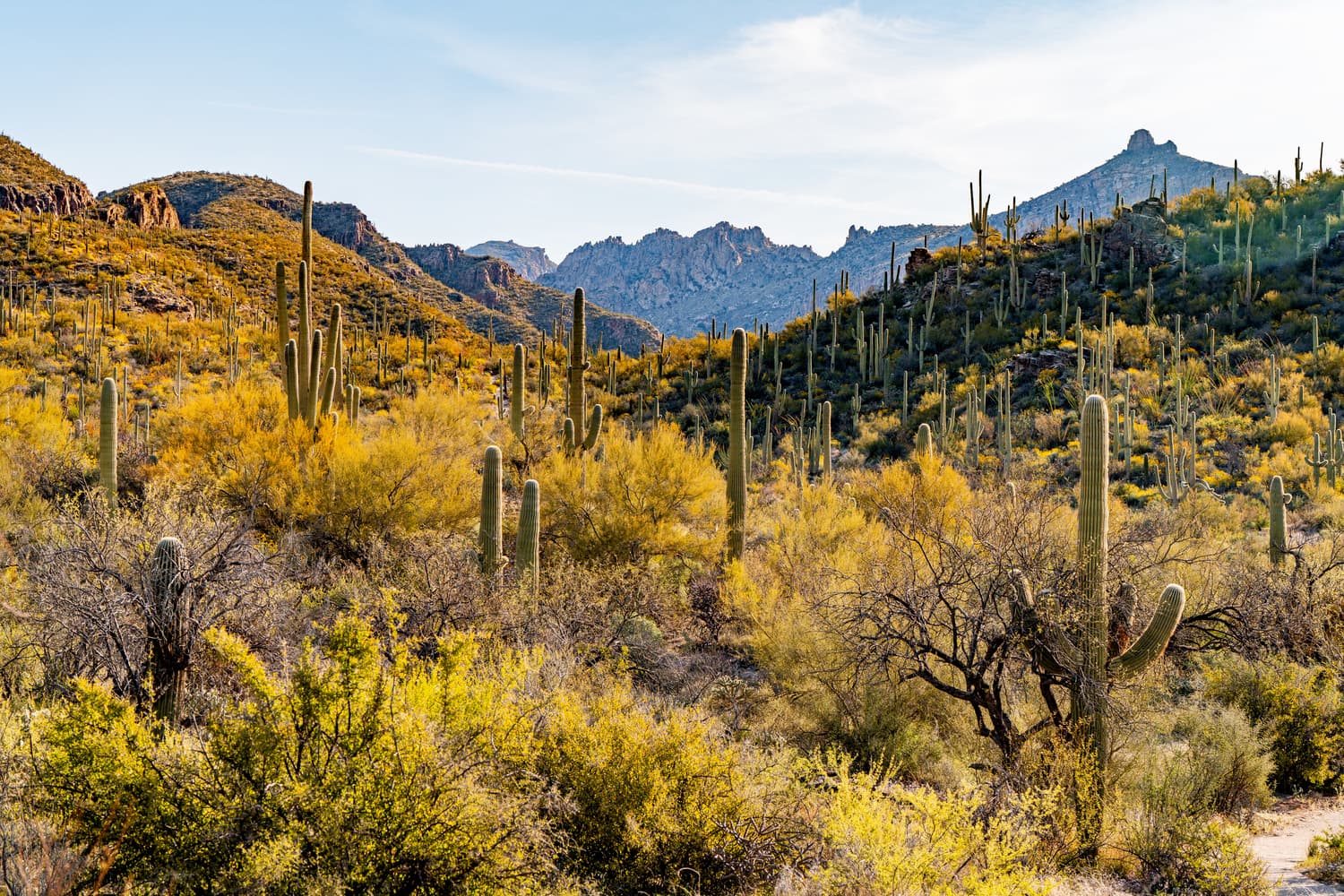
Arizona Sonora Desert Museum view. Courtesy of Steven Meckler.
Desert Morning
At dawn, a pale southwestern sun casts a guava glow across the Catalina Mountains, eventually bathing Tucson in a new day’s light. During the cool, fresh mornings, cyclists take to The Loop, a 137-mile paved path encircling Tucson’s metro area. The route follows the dry beds of the Rillito and Santa Cruz Rivers, linking parks, neighborhoods, and trailheads without crossing traffic or encountering a car. From nearly any point, rider views are framed in mountains: the Catalinas to the north, the Rincons to the east, the Tucson Mountains to the west.
Few cities in America have been built in concert with the landscape. Most attempt to conquer it. Yet, Tucson is a city that runs on the desert’s clock, humbly living within the constraints of a hot, arid environment.
As Azure Road debuts its second American city for its Sustainable City Guide series, Tucson proved a compelling choice, if less obvious to the average American. Here’s why.

Sabino Canyon Recreation Area Courtesy of Visit Tucson.
Building a Sustainable City
Tucson’s approach to conservation and development has long remained shaped by climate and scarcity. Average annual rainfall is less than twelve inches, yet the city has built one of the most advanced water-management systems in the American Southwest.
The One Water 2100 Plan coordinates reclaimed water, stormwater capture, and groundwater recharge under a single framework. Roughly 12% of Tucson’s total water use now comes from recycled sources with the goal of increasing that number. The purple-pipe system delivers reclaimed water to irrigate golf courses, parks, and school fields while recharge basins return excess supply to underground aquifers.
While many American cities and communities suffer the consequences of overdevelopment without thought for water or clean energy, Tucson’s leadership has managed the opposite. While many American cities overdevelop without accounting for water or energy use, Tucson’s leadership has taken the opposite approach. The city’s long-term planning, backed by consistent policy, has positioned it as a model for urban management.
In contrast to some Western states like Colorado that only recently loosened restrictions, Tucson has long embraced rainwater harvesting. City code and incentive programs encourage new developments to harvest stormwater on-site, directing runoff to landscaping instead of storm drains through the Storm to Shade initiative.
Tucson Water offers residents rebates—up to $2,000—to install cisterns, basins, and other rainwater-harvesting systems that retain rainfall on-site. In a desert environment, these measures function as both adaptation and insurance against future drought.

Sunlink Streetcar aerial street view. Courtesy of Visit Tucson.
The city has also taken measures to address the warming climate. For anyone familiar with climate policy and the socioeconomic implications for poorer classes living in defoliated boroughs of hot concrete, Tucson has taken a different approach.
The Million Trees Initiative highlights a shift in values. Tucson plans to plant one million trees by 2030, focusing on neighborhoods with the least shade and highest surface temperatures. Research shows canopy coverage can lower street heat by up to 15°F, a public-health investment as much as an environmental one.
The program works alongside Tucson Clean and Beautiful, a nonprofit coordinating planting and maintenance efforts across the region. Why don’t all American cities do this? A question of priorities and values.
City leadership has also accounted for cleaner air and reduced energy by helping eliminate car reliance – or providing transport for those without reliable transport, through an electric streetcar. The Sun Link Streetcar runs 3.9 miles between the University of Arizona, Fourth Avenue, downtown, and the Mercado District, carrying several thousand passengers daily, reducing short car trips and connecting key development corridors. In fact, Tucson is one of the only U.S. cities with fare-free public transit. For cyclists and pedestrians, the aforementioned The Loop remains one of the country’s largest continuous urban trail systems.
Tucson also protects its most overlooked natural resource—the night sky. The city enforces one of the nation’s strictest outdoor-lighting codes, requiring shielded fixtures and low-lumen bulbs to minimize glare and light pollution. These dark-sky standards not only support nearby astronomical observatories like Kitt Peak and Mount Lemmon, but also make Tucson a rare metropolitan area where the Milky Way remains visible on its Astro Trail. The region has become a hub for astrotourism, with designated dark-sky parks that celebrates the firmament’s brilliance after sunset.
This ethic of conservation doesn’t stop with city planning—it runs through Tucson’s businesses and hospitality industry, too. The AC Hotel Tucson Downtown holds LEED certification, while the boutique Armory Park Inn, restored from a 1875 adobe residence, maintains natural temperature control through its original walls. In the foothills, properties like Loews Ventana Canyon operate on reclaimed water and landscape with native vegetation.

Armory Park Inn's common hall couch seating. Courtesy of Armory Park Inn.
Community Mobility and Advocacy
Sustainability in Tucson extends beyond infrastructure into policy and advocacy. The nonprofit Living Streets Alliance (LSA) has become one of the city’s most influential civic organizations, working to redesign streets around people rather than cars.
LSA pushes for Complete Streets standards—design guidelines that make roadways safe and accessible for everyone, whether they walk, bike, ride transit, or drive—while also advocating for fare-free transit and long-term funding to support it. The organization also works within the Regional Transportation Authority’s RTA Next planning process, pushing for fair investment so that future transportation dollars benefit every neighborhood, not just the most affluent.
The group’s mission extends beyond policy into hands-on community change. Its core programs—Open Streets, Safe Routes to School, and Community Engagement—translate advocacy into measurable public benefit. Open Streets events reclaim roadways as public spaces for play, movement, and community connection. Safe Routes to School helps children and families navigate daily travel without relying on cars, while community engagement campaigns build long-term support for more inclusive and accessible design.
Cyclovia Tucson, organized by LSA twice a year, brings these values into motion. The event closes miles of city streets to traffic and fills them with walkers, cyclists, families, and local vendors. Tens of thousands of residents participate, showing how shared streets can shift behavior and remind people that roads belong to everyone.

Mission Garden view. Courtesy of Steven Meckler.
Living Heritage
Environmental planning in Tucson is reinforced by cultural continuity. The region has supported human settlement for at least 4,000 years. Tracing back to the Hohokam culture and including communities such as the Tohono O’odham and Pascua Yaqui, the region’s agricultural traditions stretch across millennia. Their floodplain irrigation systems and desert crops continue to serve as inspiration for land-use and food-production practices today.
In the Barrio Viejo neighborhood, many 19th-century adobe row houses still stand; protected by preservation ordinances and restored by private owners, they continue to function as homes, cafés, and inns. Thick earthen walls and shaded courtyards moderate temperature naturally, a building method still suited to the climate.
At the base of Sentinel Peak, Mission Garden maintains working plots that represent each era of Tucson agriculture: Indigenous, Spanish, Mexican, and Territorial. Volunteers grow tepary beans, wheat, figs, and chiltepin chiles using historic irrigation techniques. The project partners with the City of Tucson and the nonprofit Friends of Tucson’s Birthplace, linking cultural education with agricultural research.
Across downtown and South Tucson, murals record Indigenous and Mexican history in public view. New construction uses desert-toned materials that reflect sunlight and limit heat accumulation. Modern restoration projects such as the Pima County Courthouse and the University of Arizona’s Environment and Natural Resources 2 building show how heritage design elements and energy-performance goals can work together.
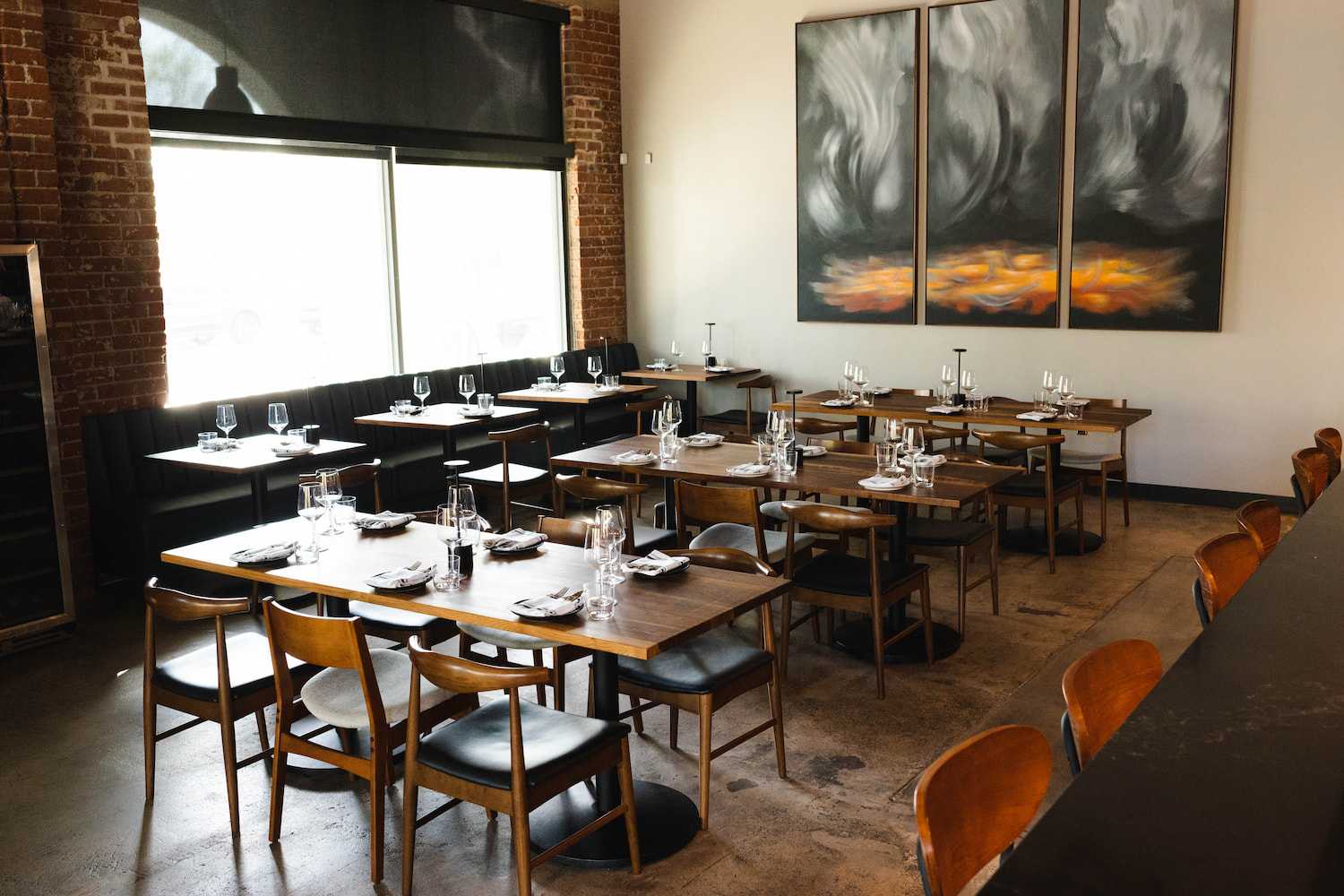
BATA's inner view. Courtesy of BATA.
Sustainability You Can Taste
In December 2015, UNESCO designated Tucson as the first U.S. member of its Creative Cities Network with the title ‘City of Gastronomy‘. The title recognized a complete food system rather than a trend. Tucson’s agriculture depends on drought-tolerant crops like tepary beans, mesquite, chiltepin, and heritage grains such as White Sonora wheat, which are well-adapted to desert conditions and are increasingly used locally.
Institutions such as Mission Garden and the University of Arizona’s Desert Laboratory continue research into these traditional foods and their role in modern diets.
Many restaurants strive to work within that system. BATA follows a 400-mile sourcing policy and operates an oak-fired kitchen meant to minimize energy use. Tito & Pep cook with mesquite wood and Arizona produce. Seis Kitchen, now with several locations, focuses on regional Mexican dishes using local suppliers. Zio Peppe reimagines Italian cuisine with borderland ingredients and desert-grown grains.
Regional supply-chain enterprises help keep ingredients local. For example, Barrio Bread mills heritage wheat grown nearby, supporting local farmers and reducing transport emissions.
The drinks sector applies the same discipline. Exo Roast Co. roasts coffee in an 1885 adobe. In the evenings, it becomes Bar Crisol, featuring agave spirits from small, sustainable producers in Mexico. Crooked Tooth Brewing and Slow Body Beer Co. brew with Arizona grains and return spent malt to composting programs. Whiskey Del Bac distills mesquite-smoked single malt whiskey, substituting a native wood for imported peat.

Saguaro National Park tourist view. Courtesy of More Than Just Parks.
Engaging Travelers in the Effort
The Tucson Stewardship Pledge, created by Visit Tucson, invites travelers to conserve water, minimize waste, respect Indigenous lands, and support local businesses. Visitors are encouraged to carry refillable water bottles and use local refill stations—reducing single-use plastic.
Visit Tucson’s website also helps you plan a sustainable visit by listing additional tips for visitors, recommending certified green hotels, Indigenous-led tourism activities, and offering information on how to ride the Sun Link Streetcar.
Local tour operators integrate conservation and community awareness directly into programming and itineraries. Borderlandia Walking Tours connects architecture, centuries of migration, and cultural history through its fascinating guided walks in Barrio Viejo and El Presidio. At the Arizona-Sonora Desert Museum, exhibits and research programs combine habitat preservation with public education on the fragility of ecosystems and the advancement of climate change.
Even recreation areas follow the same logic: the Sabino Canyon Crawler runs on electric power to cut emissions in a protected landscape, while Saguaro National Park protects one of the region’s most beautiful and fragile habitats.

Saguaro at night view. Courtesy of Ray Cleveland.
The Visitor’s Point of View
For travelers, Tucson’s sustainability measures appear in daily details. Public art, bike routes, and heritage architecture create continuity between the city’s past and future.
Of course, the city faces challenges, notably climate change. Summer temperatures are hot and getting hotter, which inevitably forces residents and visitors inside to cool down with AC. Plus, the city’s distance from other major metropolitan areas and America’s inadequate and inefficient trains mean cars are non-negotiable for locals and visitors to the area.
Yet, Tucson stands out because its leadership applies meaningful and impactful systems to residents’ daily life. For that reason, Tucson earned its place in Azure Road’s Sustainable City Guides.
This guide has been produced in partnership with Visit Tucson.

Founder and CEO of Azure Road, Lauren Mowery is a longtime wine, food, and travel writer. Mowery continues to serve on Decanter Magazine’s 12-strong US editorial team. Prior to joining Decanter, she spent five years as the travel editor at Wine Enthusiast. Mowery has earned accolades for her writing and photography, having contributed travel, drinks, food, and sustainability content to publications like Food & Wine, Forbes, Afar, The Independent, Saveur, Hemispheres, U.S. News & World Report, SCUBA Diving, Plate, Chef & Restaurant, Hotels Above Par, AAA, Fodors.com, Lonely Planet, USA Today, Men’s Journal, and Time Out, among others.
Pursuing her Master of Wine certification, she has also been a regular wine and spirits writer for Tasting Panel, Somm Journal, VinePair, Punch, and SevenFifty Daily. Mowery is a graduate of the University of Virginia and Fordham Law School, and she completed two wine harvests in South Africa.
Follow her on Instagram @AzureRoad and TikTok @AzureRoad
North Stars: Climate Action, Heritage Value, Water Management