North Stars:

Community Support

Wildlife Ecosystems

Heritage Value
“There are people in the environment, which makes the area special.”

Tuskers in Tanzania. Courtesy of Summer Rylander.
“Give yourself space; don’t bunch. Be like wildebeests, they can always get away,” Åke Lindstrom advises our small group as we clamber onto our bikes. I’m happy for the caution, as it’s my first time riding an e-bike and I’ve not yet adjusted to how much larger and heavier (and faster) it is than my city bicycle back home — I prefer everyone keep their distance as I wobble.
I didn’t expect my first e-bike experience to be on Tanzanian plains, but life has a funny way of putting you where you need to be. For now, it’s the Enduimet Wildlife Management Area (WMA). This 752km² expanse of land sits within the West Kilimanjaro Basin, which connects with the Amboseli plains of neighboring Kenya. That it’s a WMA instead of a national park means indigenous Maasai communities not only benefit directly from tourism funds, they have a hand in operations — a harmony that helps ensure continued conservation of wildlife and habitat. This particular area is reputed for its super tuskers and the marvellous elephants, whose tusks weigh 100 pounds or more each, can lumber unbothered over this flat, open land with minimal disruption from vehicular traffic.

Capturing a moment amid the journey. Courtesy of Summer Rylander.
Seeking Out the New
As overtourism in the Serengeti continues to escalate to truly problematic levels, it’s exciting to see an uptick in interest in off-the-beaten-track activities. Indeed, it was hard to miss safari guide and photographer Nick Kleer’s viral posts in July this year, capturing dozens of vehicles blocking the path of migrating wildebeest after a river crossing.
Leonotis Adventures specializes in exactly this beat in northern Tanzania, and while it was a thrill to cycle in the vicinity of tuskers and speed downhill in the rain on Mt. Kilimanjaro’s Shira plateau (I did eventually find my balance on the big e-bike), what I’d really come for was approximately 40 miles of trekking through landscapes most visitors won’t even see by vehicle, let alone on foot.
“There are people in the environment, which makes the area special,” Lindstrom, the Kenyan-born, longtime Tanzania resident and managing director of Leonotis Adventures, tells us as we make an early departure from our fly camp at the rim of Empakai Crater.
We’d descended into the lush crater the afternoon before, zigzagging down a steep path into the depths of the 980-foot caldera and making it back out just before dark. Much of the crater’s floor is covered by an alkaline lake, which reflected the fading daylight with such startling beauty that my mind had begun to narrate the scene as otherworldly — a moment I’d find myself quietly laughing at later that evening in my tent. Even as someone whose work is focused on the natural world, I’m still detached enough that my screen-blasted brain can perceive an example of the very essence of this planet as something unreal.
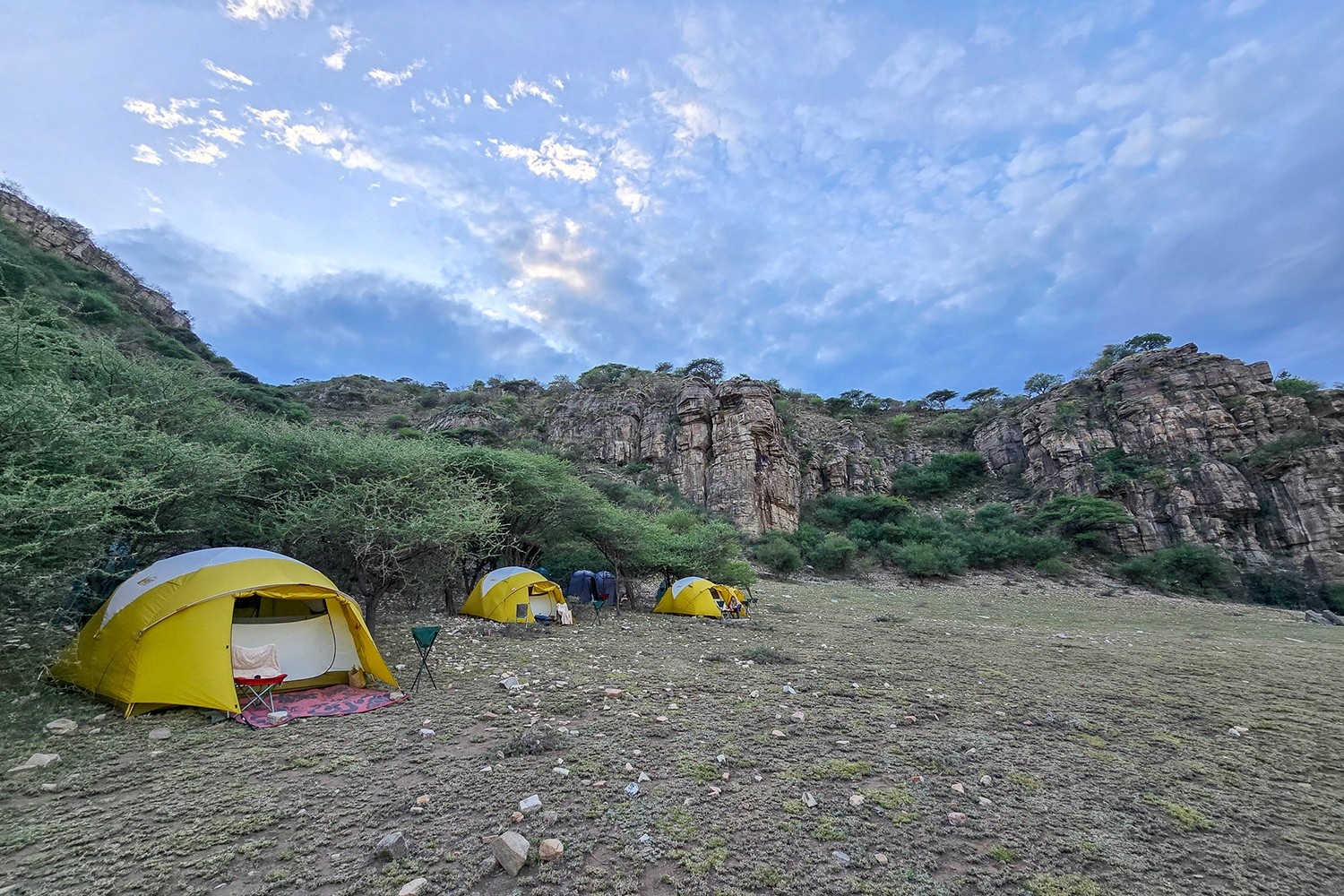
Camping for the night. Courtesy of the Summer Rylander.
Overlanding in Africa
The morning’s uphill plod through dense, dew-covered jungle eventually spills into an open expanse of land where greenery in every shade imaginable covers small hills, far-off peaks, and gently sloping meadows.
Maasai boma punctuate the landscape like dots on a scatter plot — the subtle clusters of circular huts and livestock enclosures giving credence to Lindstrom’s claims. There are people in this environment, yes, and these Maasai lands are not a performance. This is not a calculated cultural exchange; it’s just a slice of land and the people who call it home.
As we wind our way down the valley, we skirt many of these homesteads, exchanging passing greetings with the men and women who are going about their days tending cattle or hanging laundry or relaxing in the shade as the late-morning sun dials up its intensity. Young children are the most enthusiastic, waving vigorously and shouting “HELLO! HELLO!” with big smiles as we trek onwards, waving back with smiles of our own.
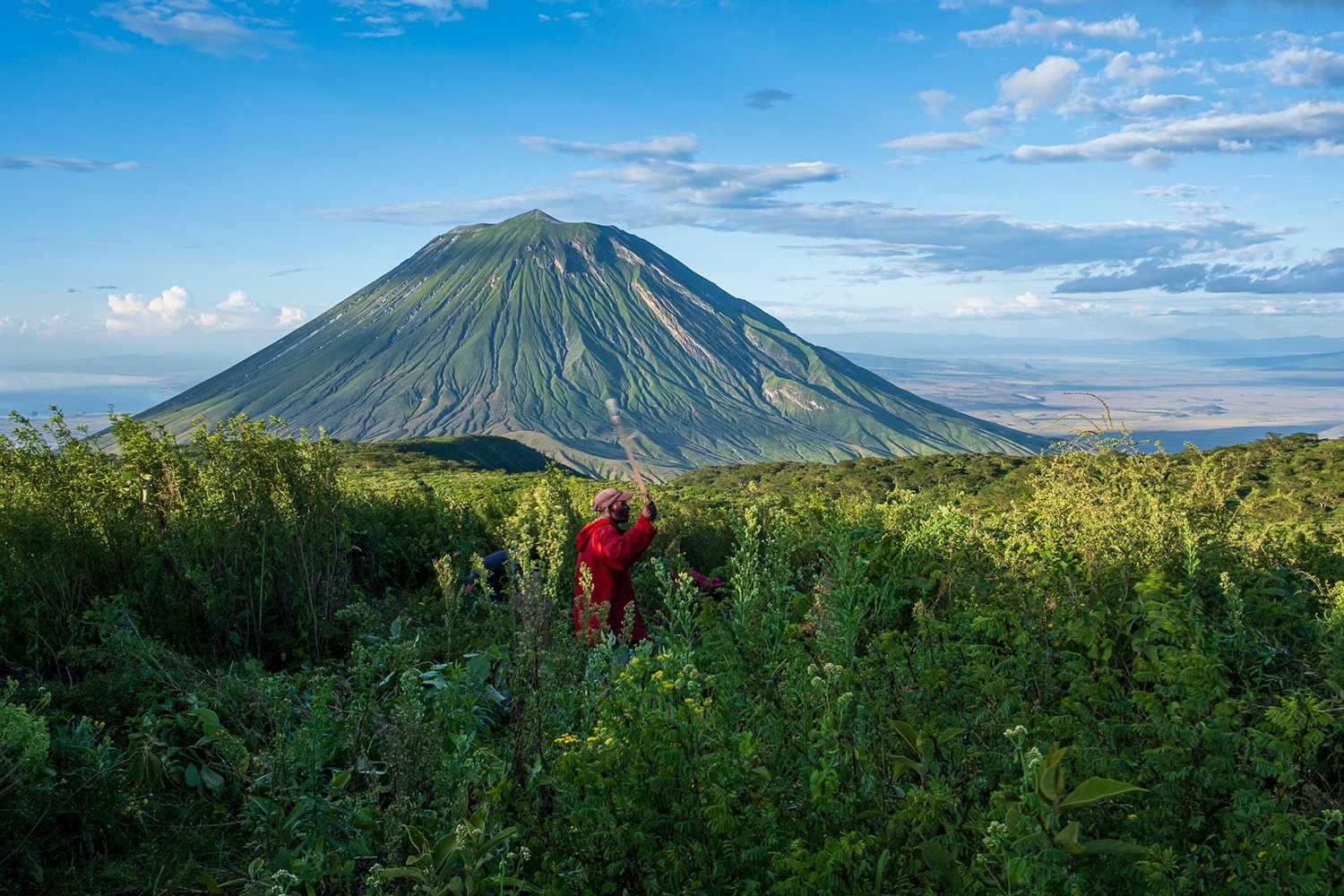
Omnipresent now is Ol Doinyo Lengai, an active volcano reaching 9,718 feet at the summit of its pleasingly symmetrical form. Between the shifting hues of Lengai’s green flanks, the tendrils of rising steam, and the snow-like white patches from its unique natrocarbonatite lava, I can’t take my eyes off of this mountain, and my phone gallery quickly fills with repetitive captures.
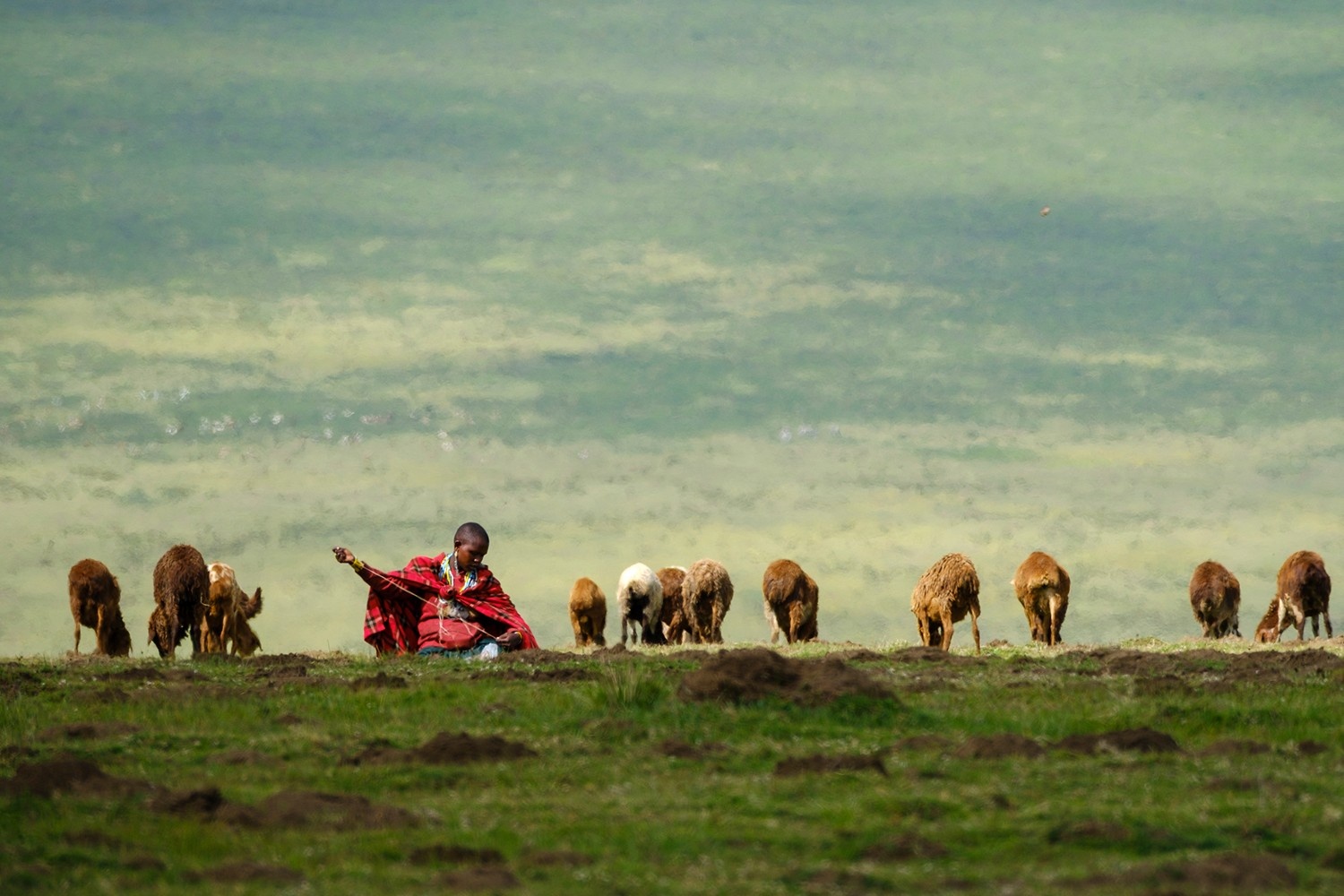
All in a day's work on the African plains. Courtesy of Summer Rylander.
I’m not the only one who is gawking. Lindstrom tells us he’s happy to lead an ascent in two night’s time for anyone who is interested, and for about half a second, I consider the challenge, until my mind works through the inevitable repercussions of a six-hour slog straight uphill, followed by a punishing downhill over slippery scree. Climbing Kilimanjaro a year and a half prior already taught me that my knees are not as resilient as I’d once thought. Admiring Lengai from afar will more than suffice.
I do, however, join for a side-quest hike after reaching the evening’s campsite, where a handful of tents have been pitched amongst a grove of acacia trees and abundant leonotis nepetifolia flowering in all of their tubular orange glory, giving the camp its nickname: Leonotis.
Our post-trek walk sees us spiraling up a hillside via a path so fresh there are still men hacking away at the soon-to-be clearing at the top, the sun glinting off their raised blades as Lengai watches over. It is a spectacular sight, and when the makings of a gin and tonic (including ice, somehow) are produced from someone’s backpack and a cold drink is placed into my hand, the moment soars to the top of my Most Memorable Sundowners list.
For additional reading on Tanzania and African safaris, check out our guide to ethical Tanzania safaris; a favorite sustainable Tanzania safari lodge; seven secret Southern Africa safari destinations; sustainable farming at safari lodges; and the challenges of overtourism in the region.

Summer Rylander is a freelance travel and science journalist covering positive-impact tourism and the conservation of our biodiverse planet. Follow Summer on IG @summeroutside.
North Stars: Community Support, Heritage Value, Wildlife Ecosystems
More Stories
 CULINARY, DRINK
Get to Know the Producers Behind the J.P. Bourgeois Portfolio
 CULINARY, DRINK
Where to Taste Wine in Willamette Valley
 DRINK
DRINKMeet the Distillery Making Vodka From Fog
 DRINK
DRINKSake’s Next Step: How Japan’s Rice Wine Is Evolving
 DRINK, HOME
The Buzz on InFizz: Breville’s Carbonator Elevates Sparkling Water