North Stars:

Production & Consumption

Certifications

Wildlife Ecosystems
“I was entranced by the idea that our farm could be part of a climate solution instead of a climate problem.”
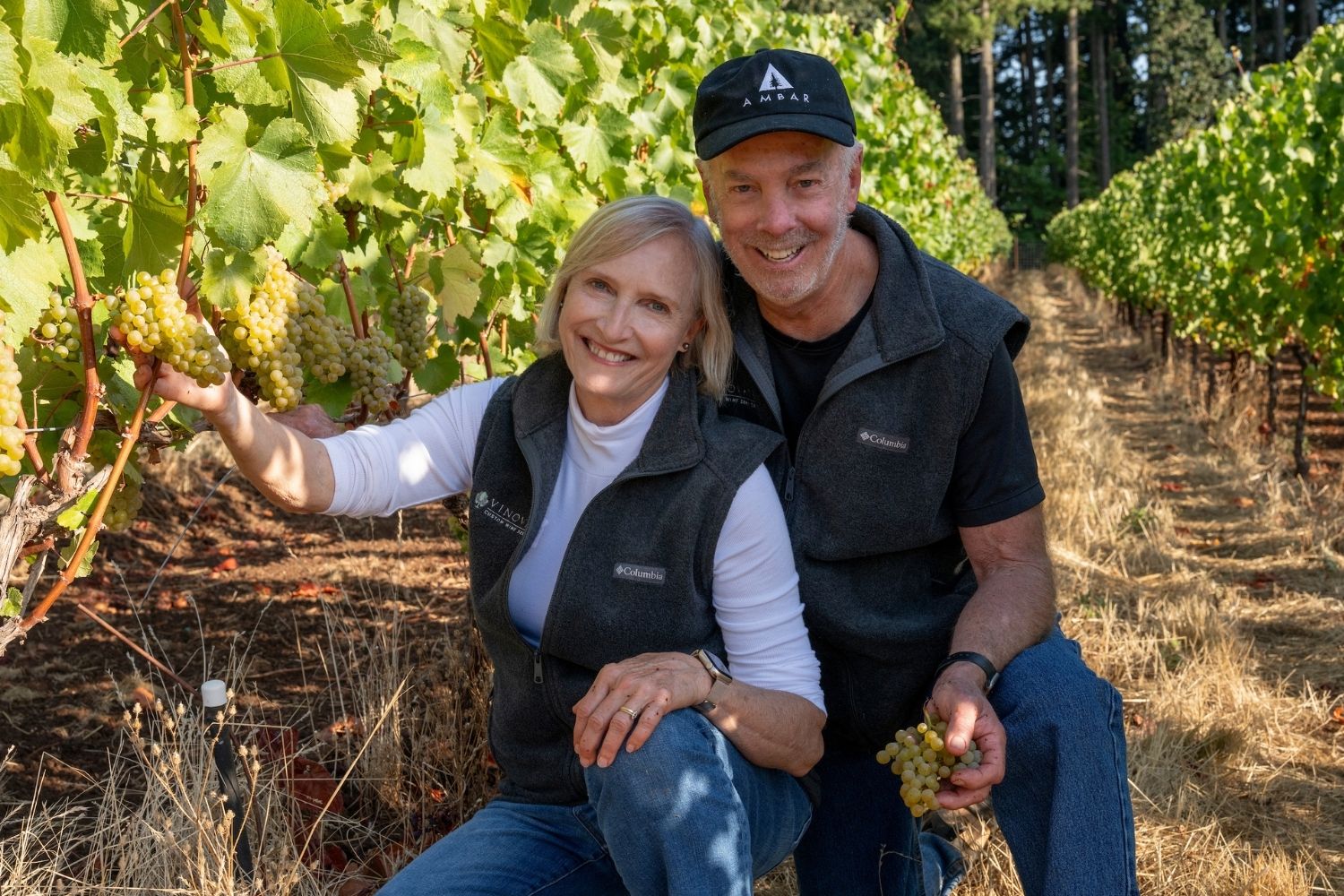
Pamela Turner and Robert Townsend in front of their vineyards. ourtesy of Andrea Johnson
Partnership
Arriving at Ambar Estate begins the way most good wine days begin in the Willamette Valley, a slow drive through stands of towering evergreens and the sense that you’re being pulled away from your inbox and into something special.
On approach, a glass-and-wood tasting room cuts a modern frame against the sky. The building wraps around a towering tree, its branches casting dappled light over gravel paths and native plantings. A host steps out with a welcome pour of Chardonnay. From the patio, the view resolves into tidy rows of vineyards stitched together with bright cover crops, trimmed in forest and the outline of Mount Hood on the horizon. The scene feels calm and unfussy in that very Dundee Hills way, but nothing about how this place is farmed happened by accident.
Hinting at the clean lines of Asia, the winery conveys intentionality. Architect Juancarlos Fernandez of Signum Architecture laid out three low-slung buildings around a heritage redwood, linking them with simple walkways so the structures read as a small compound rather than one monolithic room. Landscape architect Hoichi Kurisu, long associated with the Portland Japanese Garden, shaped the courtyard and plantings so each path and window frames a slice of sky, tree, or vine.
Ask Pamela Turner or Robert Townsend what they’re proudest of, though, and they don’t start with the building. It all starts from the ground up.
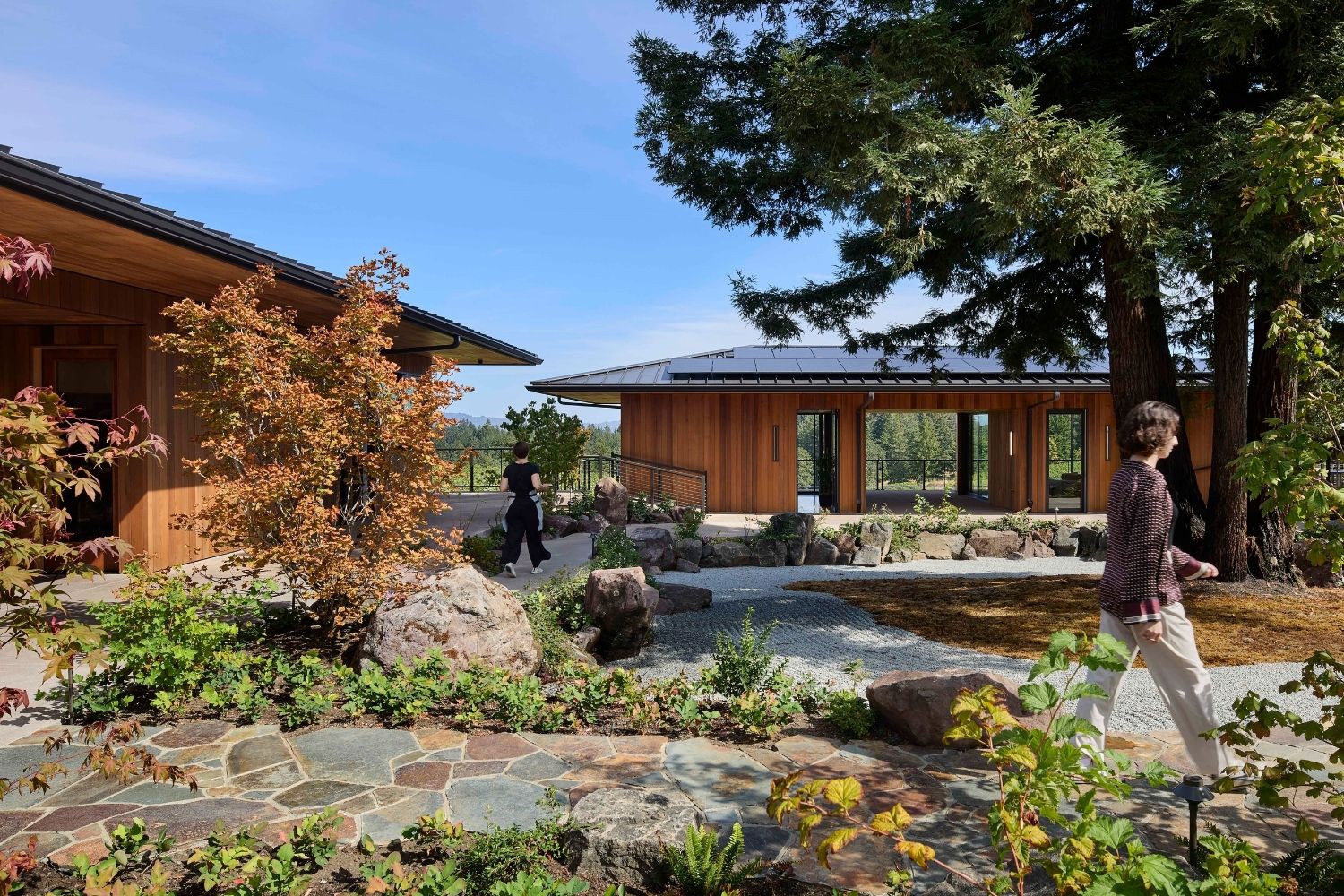
Ambar Estate Tasting Rooms. Courtesy of Jeremy Bittermann
From the Dust Bowl to Regenerative Farming
Pam grew up hearing what happens when farming goes wrong. Her grandparents worked as cotton farmers in the Texas Panhandle in the 1930s, part of the region later labeled the Dust Bowl.
“The Dust Bowl was partly a climate swing,” she says, “but it was also a man-made disaster because of the tilling practices. They tilled and tilled and tilled. When the dry spell came, everything turned to dust, and then came the winds, and it just blew all the topsoil away. You can’t restore topsoil in a season. It takes a lifetime.”
That loss pushed her mother’s family west to California as part of one of the largest internal migrations in U.S. history. The story stayed with her.
Those memories sat in the back of her mind years later as she and Rob began looking for land in the Willamette Valley. Through a friend, they heard about an ideal twenty acres in the Dundee Hills: Jory soils, eastern aspect, never farmed, though overgrown with invasive blackberries and poison oak.
“I arranged for the closing of the purchase to be on Pam’s birthday,” Rob recalls. From day one, they committed to building an organic vineyard, one supported by native plant restoration and farming that would build soil instead of stripping it.
Pam’s background as a science writer and public health professional meant she didn’t stop at “organic.”
“I went down the rabbit hole on farming practices,” she says. “Organic, biodynamic, all of it. . While there is merit in those approaches, I wanted something more rigorous and science-based.”
Extensive research on soil biology, climate change, and carbon sequestration led the couple to pursue Regenerative Organic Certification® (ROC), a standard that adds strict requirements for soil health, biodiversity, as well as worker welfare on top of organic farming requirements. As Rob noted “conventional farming destroys the soil and endangers human health, organic farming preserves the soil, and regenerative farming actually improves the soil and the ecosystem.”
“When I read about Regenerative Organic Certification and how it requires farming practices that prevent disasters and tragedies like the Dust Bowl,” she says. “I think they’d still be in Texas if that hadn’t happened. I’d be a Texas girl.”
Pam says she was “entranced” by the idea that their farm could be part of a climate solution instead of a climate problem: “That by not tilling, we could sequester carbon in the soil and make the land better, not just sustain it.”
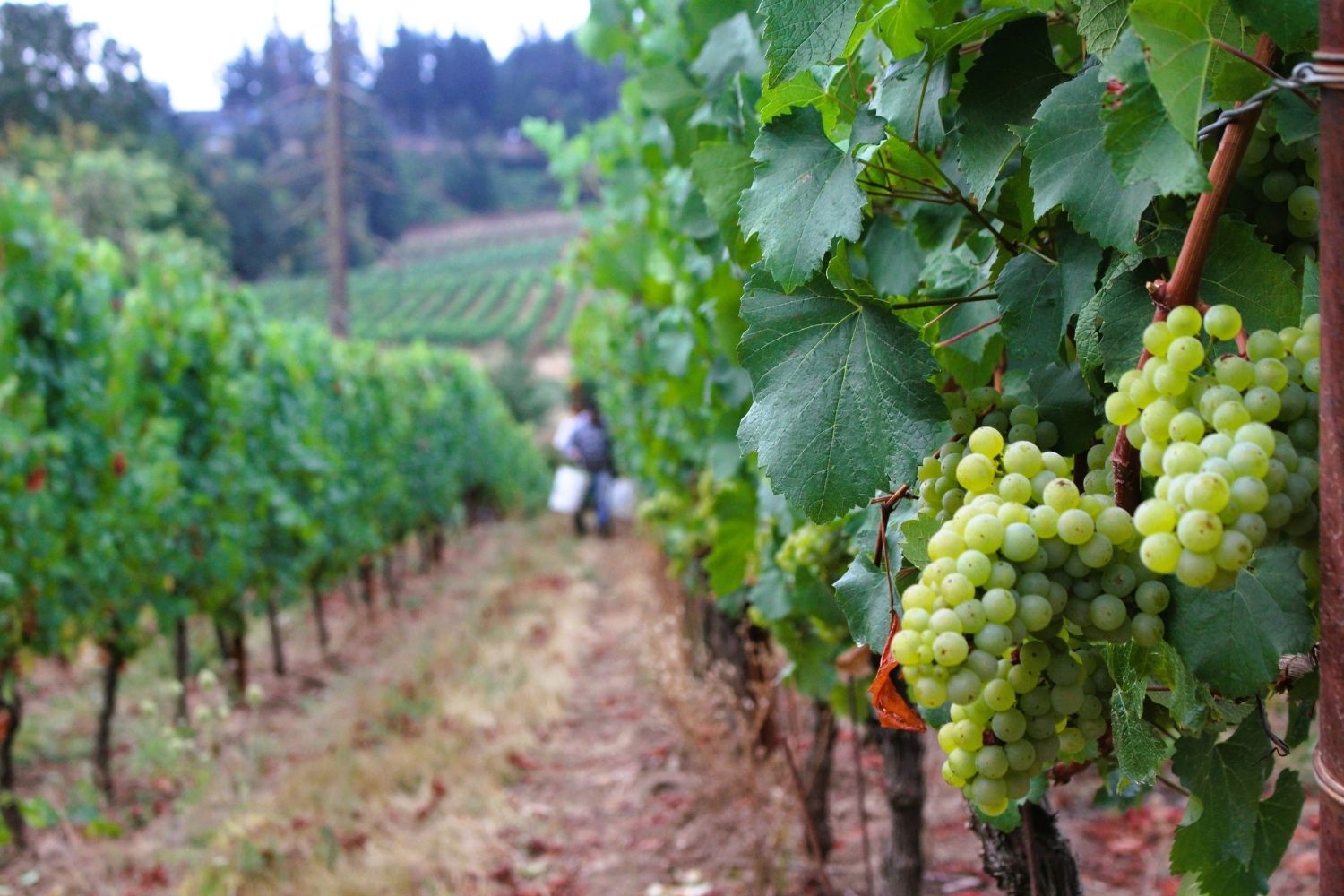
Regenerative Organic Vineyards at Ambar Estate. Courtesy of Morgan Baer
Ambar went through extensive audits and paperwork before earning ROC status, becoming the first Regenerative Organic Certified® vineyard in the Willamette Valley and one of only a small number of certified wineries worldwide. “We very much feel like we’re in the vanguard here,” Rob says. “A pebble intentionally cast into the pond, hoping to create ripples.”
Of course, Pam doesn’t sit guests down for a Dust Bowl lecture with their glass of Chardonnay, but it lingers behind choices both visible and invisible in the vineyard. And it’s hard not to think of those stories in the current context.
Zoomed out, the conditions that produced the Dust Bowl haven’t disappeared. Modern analyses suggest U.S. croplands are still losing soil at unsustainable rates. A 2020 report from the Union of Concerned Scientists notes that, although erosion has slowed since the 1980s, U.S. farms still lose at least twice as much soil to erosion each year as the Great Plains did annually during the peak of the Dust Bowl.
And the dust has literally returned to the air. On May 16, 2025, a major dust storm formed over farmland in central Illinois and raced northeast into the Chicago metropolitan area. The National Weather Service issued four Dust Storm Warnings during the event. For context, the last dust storm of this magnitude in Chicago happened in the early–mid 1930s. In 2025, satellite images showed a wall of dust pushing across northern Illinois and Indiana; visibility on the ground dropped to near zero in minutes, and multiple vehicle crashes were reported along major interstates.
For someone whose family left a farm because the soil blew away, the connection between farming practices and the long-term welfare of people and the ecosystem they inhabit, is anything but theoretical. At Ambar, that connection shows up in the small, daily decisions that add up to Regenerative Organic farming.
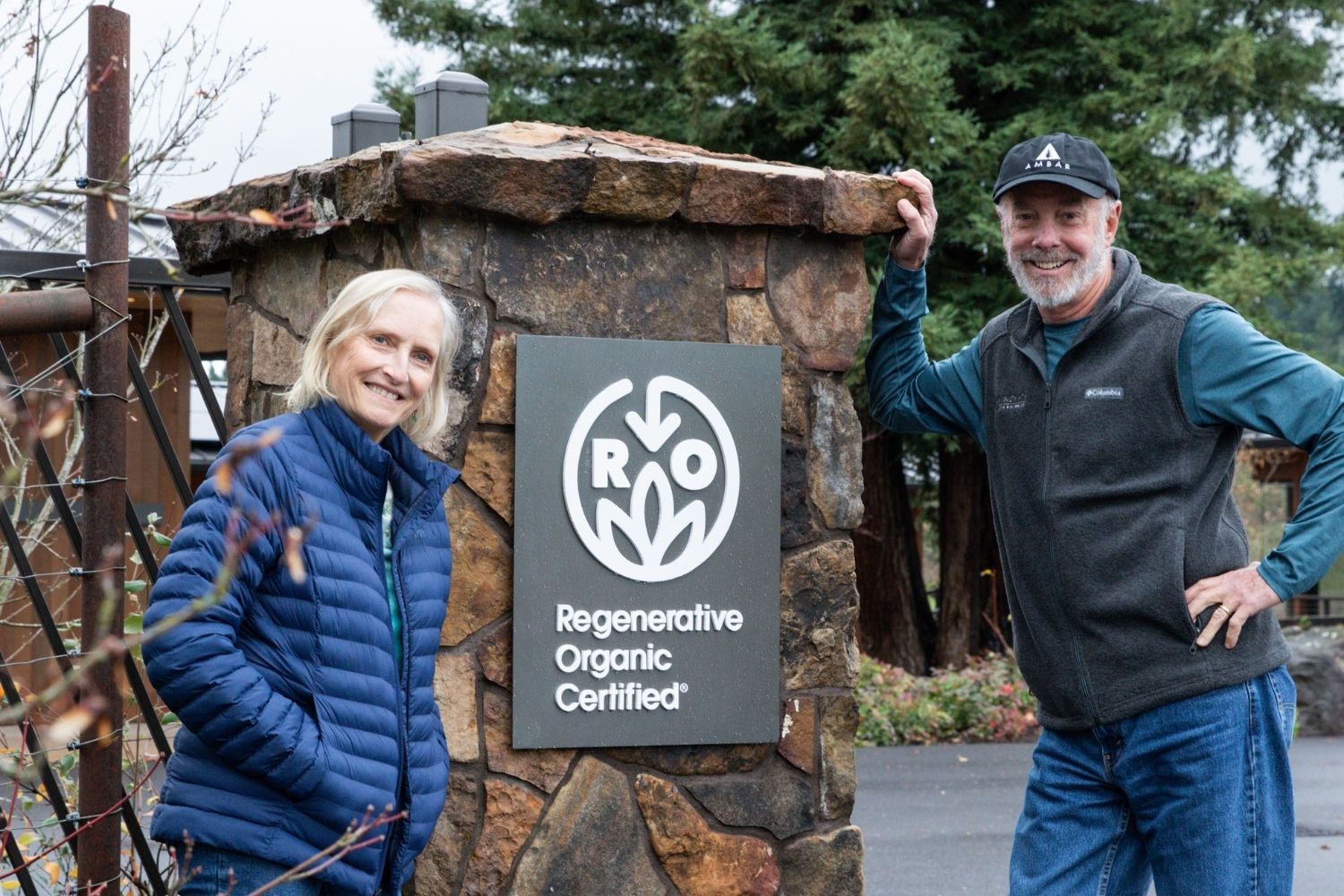
Pamela Turner and Robert Townsend in front of their certification. Courtesy of Molly Bailey
Regenerative Organic Farming in the Vineyard
ROC centers three pillars: soil health, social fairness, and animal welfare. Pam and Rob are clear that these choices are not the cheapest route. Organic farming already tends to cost more than conventional programs, but they see it as an investment in resilience: soils that hold more water, vines that cope better with heat spikes and weather swings, and a farm ecosystem where birds, insects, and microbial life work together in a holistic way.
Also, it’s a program that protects the people who work in and live near vineyards.
“Our son-in-law worked for a big vineyard management company up here, and on his first day they told him that after working in conventionally farmed blocks he needed to go home, shower, and wash all his clothes,” Rob says. Ambar doesn’t use these sprays, which means their grandkids, guests, and workers aren’t exposed to toxic chemicals.
For Pam, that safety piece sits alongside the importance of biodiversity. “Every ecosystem ever studied shows that biodiversity equals resilience,” she says.
That resilience was tested in 2024, a hotter summer growing season. General manager Julie Mettille remembers how it played out. “We began harvest at the end of August for our sparkling program. Even before September 1, we were pulling grapes in.” Yet, fruit for their still wines – the Chardonnay and Pinot Noir – stayed on the vines substantially longer, retaining enough acidity and flavor development to avoid overripe styles.
The vineyard sits at lower elevations than their neighbors. Logic would dictate the ground would be warmer, leading to an earlier harvest date.
“We think that because of our regenerative farming, the cover crops that we have, the meadowfoam that we planted, the resiliency of the soil and the increased organic matter, the site was kept cooler,” she says, “along with our east-facing exposure, surrounding forest, and wind – all natural cooling factors.” Rob pointed out that “field studies have confirmed that cover crop and no tilling helps reduce temperatures at the soil and canopy levels leading to longer hand times and greater phenolic development in the grapes.”
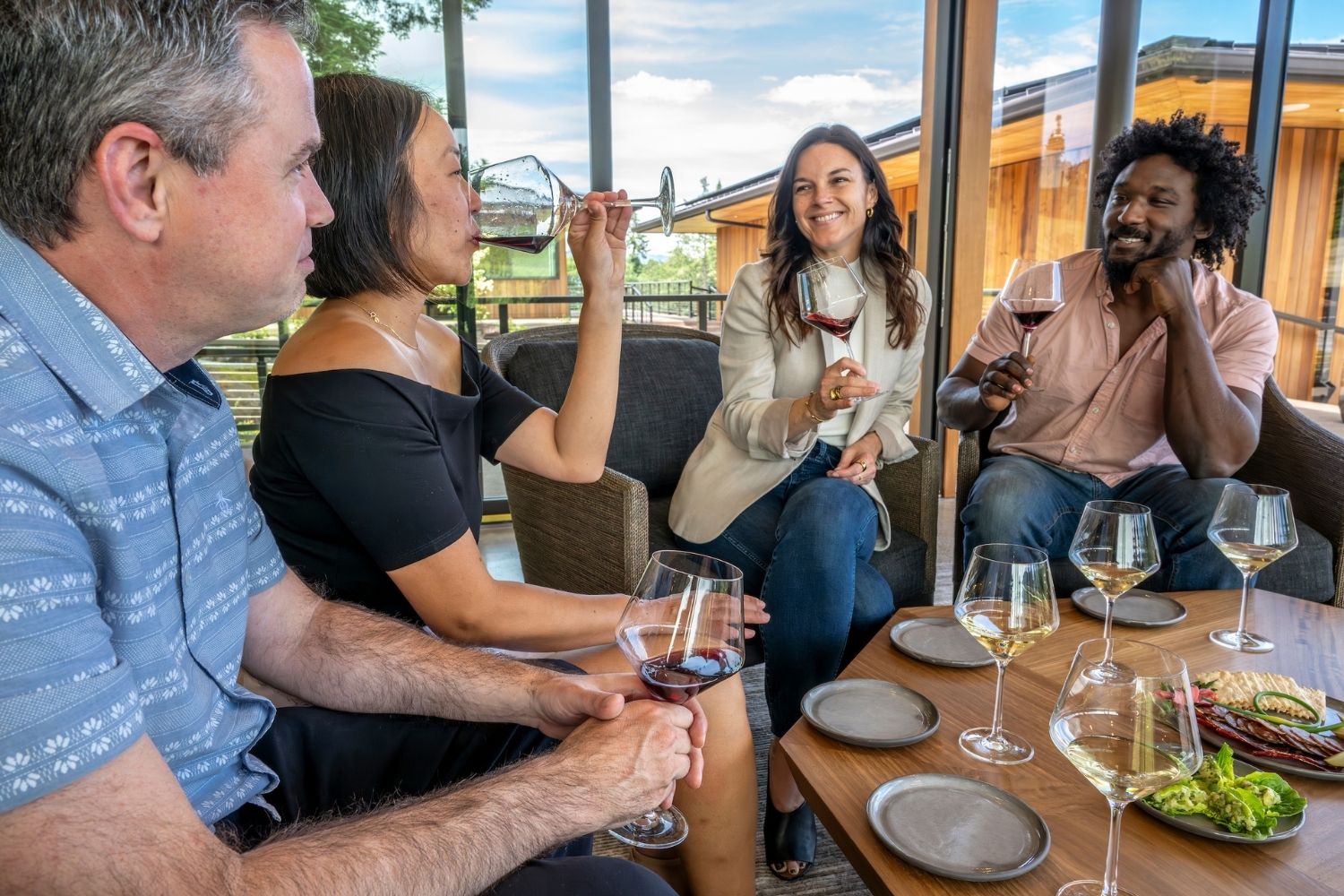
Tasting Pinot Noir at Ambar Estate. Courtesy of Robert Holmes
Hospitality as relationship, not script
When guests arrive, they’re taken for a short walk with a glass of wine. Someone from the team, often direct-to-consumer sales and marketing manager Morgan Baer, leads that first stroll. From the patio rail, she’ll point out how the vineyard floor looks more like a meadow than a manicured postcard, the vineyard dense with wildflowers and greenery in lieu of herbicide stripes. In the cooler months, Shetland sheep graze through the blocks, trimming back excess growth while fertilizing as they go.
“A lot of times guests naturally ask a lot of questions and want to know more. Some people want to talk about the science of ROC, and others want to understand what they’re seeing in the vineyard and how it connects to what’s in the glass.”
Whether it’s Morgan or Julie, they will adjust the tasting accordingly, too. “I have my baseline way of explaining what it is – the three pillars and what they mean to us – many guests connect to the fact that we pay our farm workers a living wage based on an external study of what it actually costs to pay rent and feed your family,” she says.
“We’re really in the business of building relationships, and wine is our vessel to get to know the people visiting us,” says Morgan. “By the time guests leave, we know what their dog’s name is, where they just went on vacation, what they’re doing for dinner,” adds Mettille.
Events like the annual Gold Circle dinner, where top-tier members are invited in for a multi-course evening, reinforce that sense of relationship-driven hospitality. So do the small personal moments.
“One of my favorite parts of this job is feeling like we’re invited into people’s lives. There’s a couple who joined when she was pregnant, and now I’ve met their baby. We’ve had members ask their friends to be maids of honor here. Being woven into those moments is really special,” says Morgan.
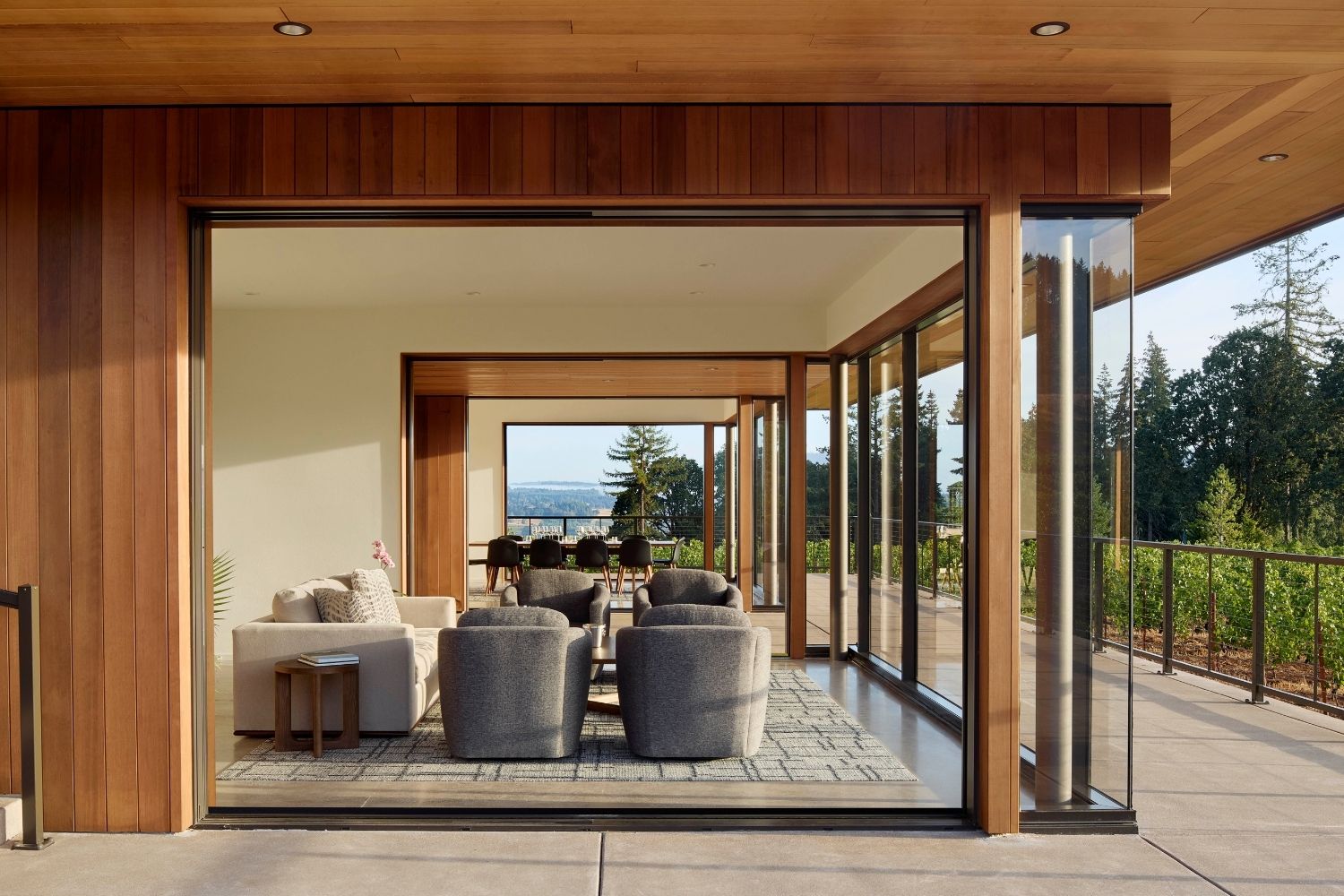
Sleek minimalist design at Ambar Estate. Courtesy of Jeremy Bittermann
Younger Drinkers Are Ambar Estate’s Core Consumer
It’s no secret that many wineries in the U.S., and globally, are suffering from lagging sales and a drop in tasting room visits. According to recent NIQ (NielsenIQ) retail scan data cited by the trade, sales of red table wine, white table wine, rosé, and sparkling wine have fallen roughly 7–9% year-over-year across major U.S. channels.
Yet Rob and Pam have a steadily growing business, with tasting room visits and club memberships largely driven by Millennials and younger guests. In essence, they’ve tapped into the real “secret sauce.” It’s not that younger drinkers don’t like wine, despite headlines about wellness and sober-curiosity.
“The millennial generation is value-motivated, and I don’t mean in terms of price. The products they’re spending their dollars on align with their values,” says Rob.
The same NIQ data, summarized in a recent Wine-Searcher analysis, shows that bottles carrying sustainability or social-impact cues are moving against the broader decline: wines labeled as B Corp are up more than 60%, those linked to Terracycle programs about 45%, and other eco or “green” claims are still growing rather than shrinking.
Awareness of B Corp skews young, too, with roughly half of Americans 25 and under recognizing the certification and about a third of consumers in the U.S. and UK saying they know what it stands for. Ambar isn’t a B Corp, but its Regenerative Organic Certified® farming and formal commitments to worker welfare slot it into the same mental category for these drinkers: a place where the glass in front of them matches the values they care about. Rob is still considering obtaining B Corp status for Ambar, but believes that the requirement of ROC certification are more demanding and specific to the winery context.
Read more about Willamette Valley, Oregon
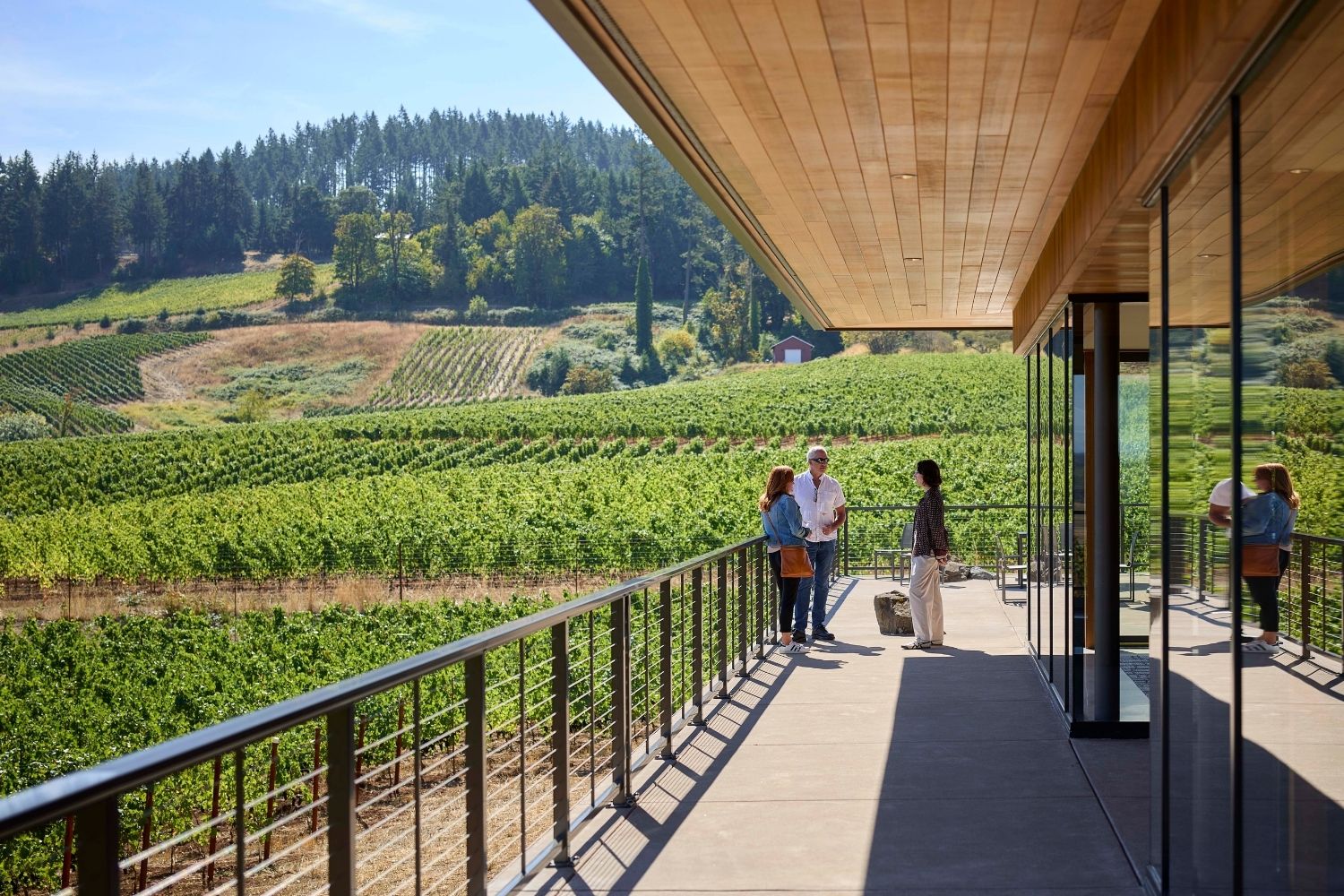
The terrace overlooking the vineyards at Ambar Estate. Courtesy of Jeremy Bittermann
When Doing Things Right Equals Great Wine
Of course, you can’t just boast about good deeds and certifications and not have the wine to back it up. For such a young label by two relatively new entrants into the wine business, Rob and Pam have achieved phenomenal success with their Chardonnays and Pinot Noirs. Both wines have scored in the mid- to high-90s across several major publications, with the Lustral single-site Chardonnay showing outstanding prowess as a generous yet elegant example of Oregon’s new star grape.
The estate is planted to multiple clones of Chardonnay and Pinot Noir, matched to slope and soil after extensive soil sonar mapping work. The first full estate vintage was 2021, and from the start, the whites in particular drew attention: focused, vibrant wines with enough weight to be satisfying but a line of acidity that quivers with tension.
In the tasting room, guests usually meet two or three expressions of Chardonnay in one visit. There is the estate blend that shows the vineyard in broad strokes, and more detailed renderings like the Lustral bottling or the Minera, a concrete-fermented cuvée.
For younger visitors who are already reading labels, checking sourcing, and thinking hard about climate and land use, that mix of farming, wine, and genuine attention feels coherent. Pam’s grandparents’ Dust Bowl stories sit at one end of the timeline. The Chicago dust storm and modern erosion trends live at the other. Ambar, on a small hillside in Oregon, is trying to be one honest, carefully farmed line connecting the two.
Get the Sustainable Wine Region Guide to Willamette Valley, Oregon
North Stars: Certifications, Production & Consumption, Wildlife Ecosystems
More Stories
 CULINARY
Azure Road Impact Award Culinary Finalists
 DRINK
DRINKAzure Road Impact Award Drinks Finalists
 DRINK
DRINKWhy Now Is the Time to Cellar Santorini Assyrtiko
 DRINK, PARTNERSHIP
Ambar Estate Is Farming for Tomorrow in Oregon’s Willamette Valley
 Columns, CULINARY, The Sip
The Sip: Craft Beer at Canyon Brewing in New Zealand