North Stars:

Carbon Footprint

Energy Efficiency

Waste Management
“Populus might be a climate-forward experiment on paper, but in the moment it reads as a clean, contemporary perch over the city.”
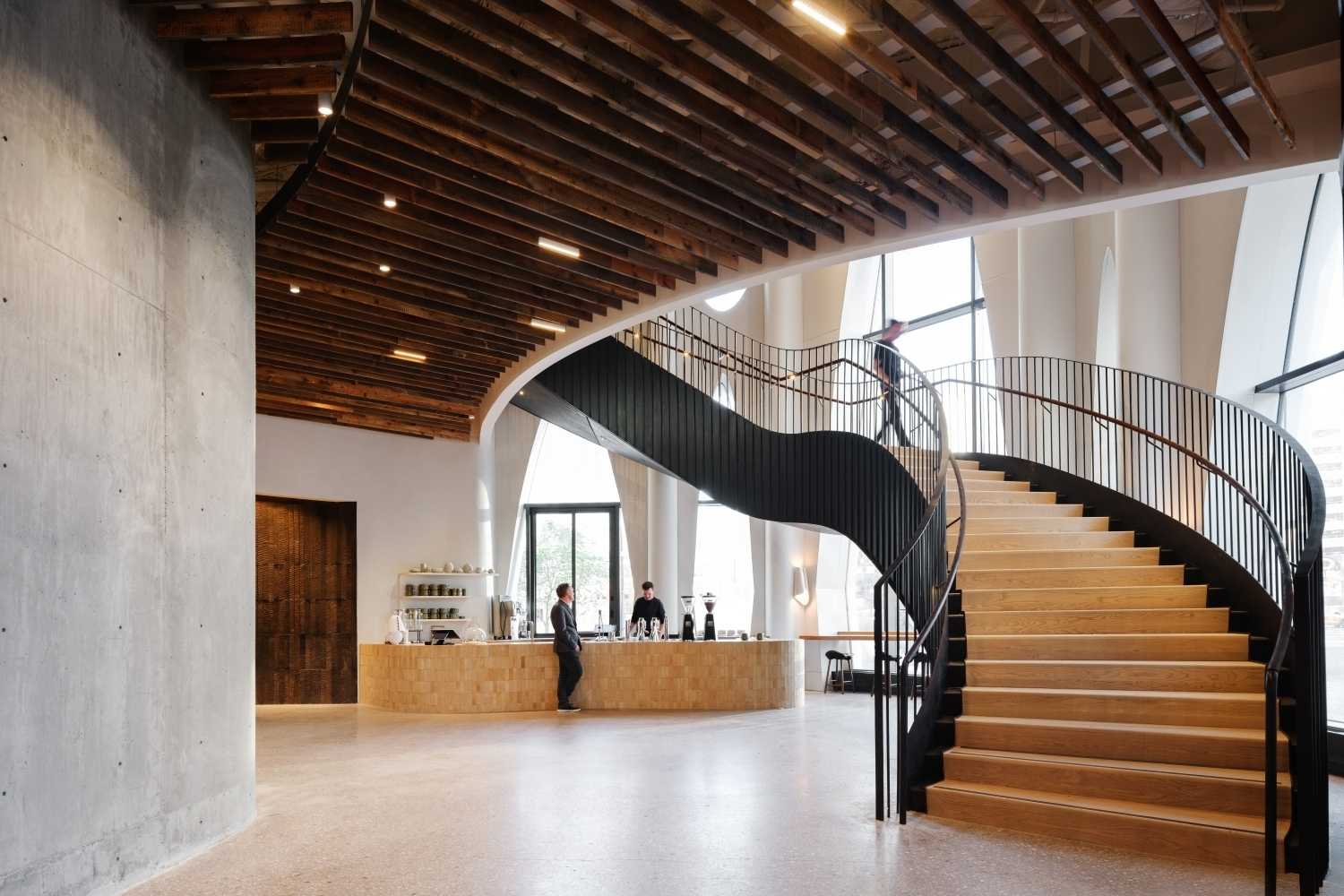
Populus Lobby. Courtesy of Studio Gang, Steve Hall.
The Azure Road Take
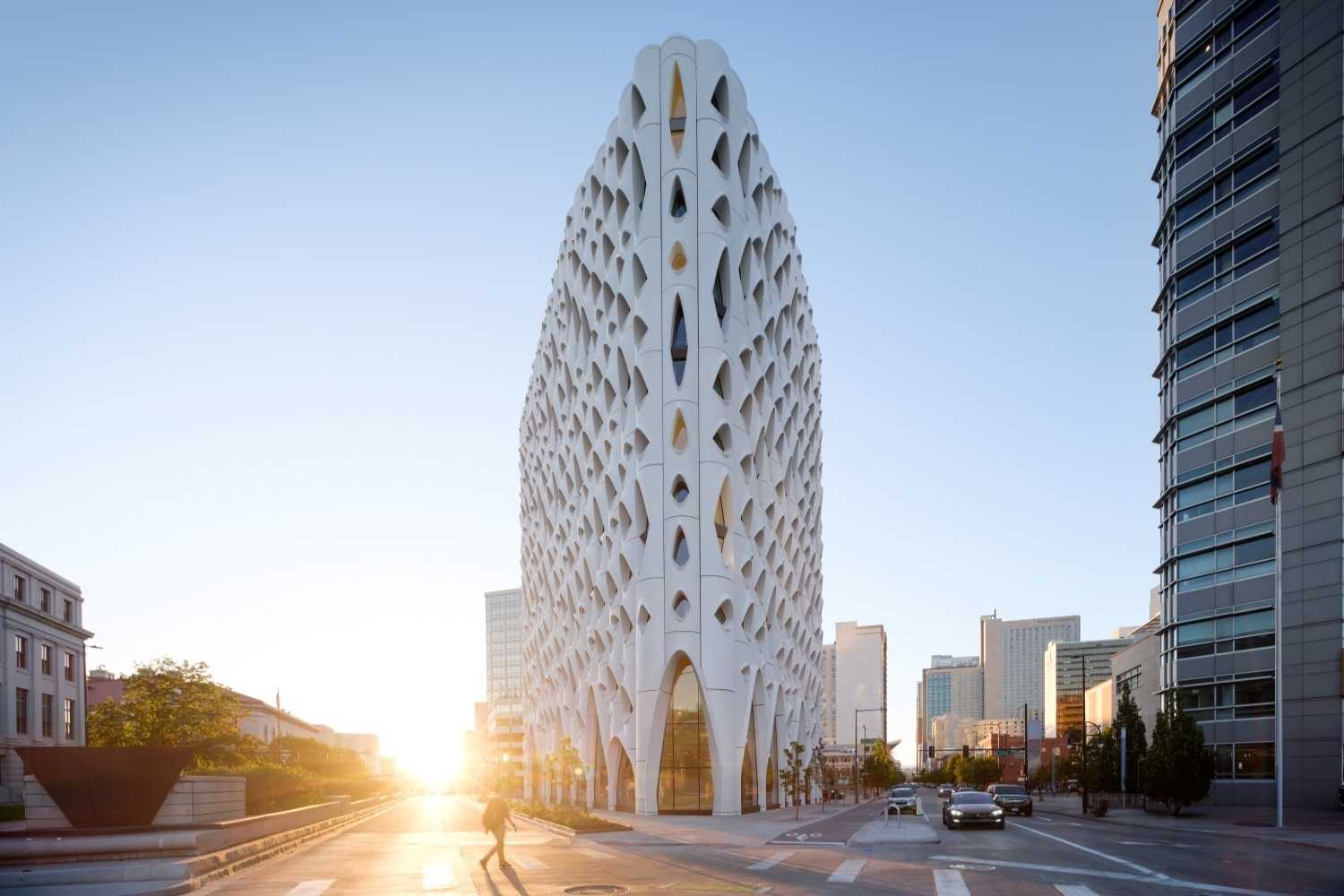
Populus does not exactly blend into its block.
It pairs a sculptural, aspen-inspired silhouette with a big promise: to operate as the country’s first carbon-positive hotel. That ambitious mission and architecture don’t, at first glance, suit its surroundings.
On a worn stretch of downtown Denver, the hotel rises as a bright white tower punctuated by deep oval openings. Inspired by the “eyes” of Colorado’s aspen trees, dark windows punctuating the cream-colored “bark” of the façade gives the building a slightly surreal, almost futuristic presence against the neighborhood surrounding it.
Inside, the contrast with the street softens. The lobby is warm and cocoon-like, all curved lines, pale wood, and amber uplighting. The same oval shapes on the exerior, become window seats and framed views in the guest rooms, so the city appears as a series of vignettes instead of one continuous wall of glass. In some rooms, the window bench wraps like a built-in hammock, quickly becoming the place for email, a book, or simply watching Denver shift from afternoon haze to evening neon.
Populus might be a climate-forward experiment on paper, but in the moment, it reads as a clean, contemporary perch over the city, with design, food, and atmosphere making the first argument for staying here.
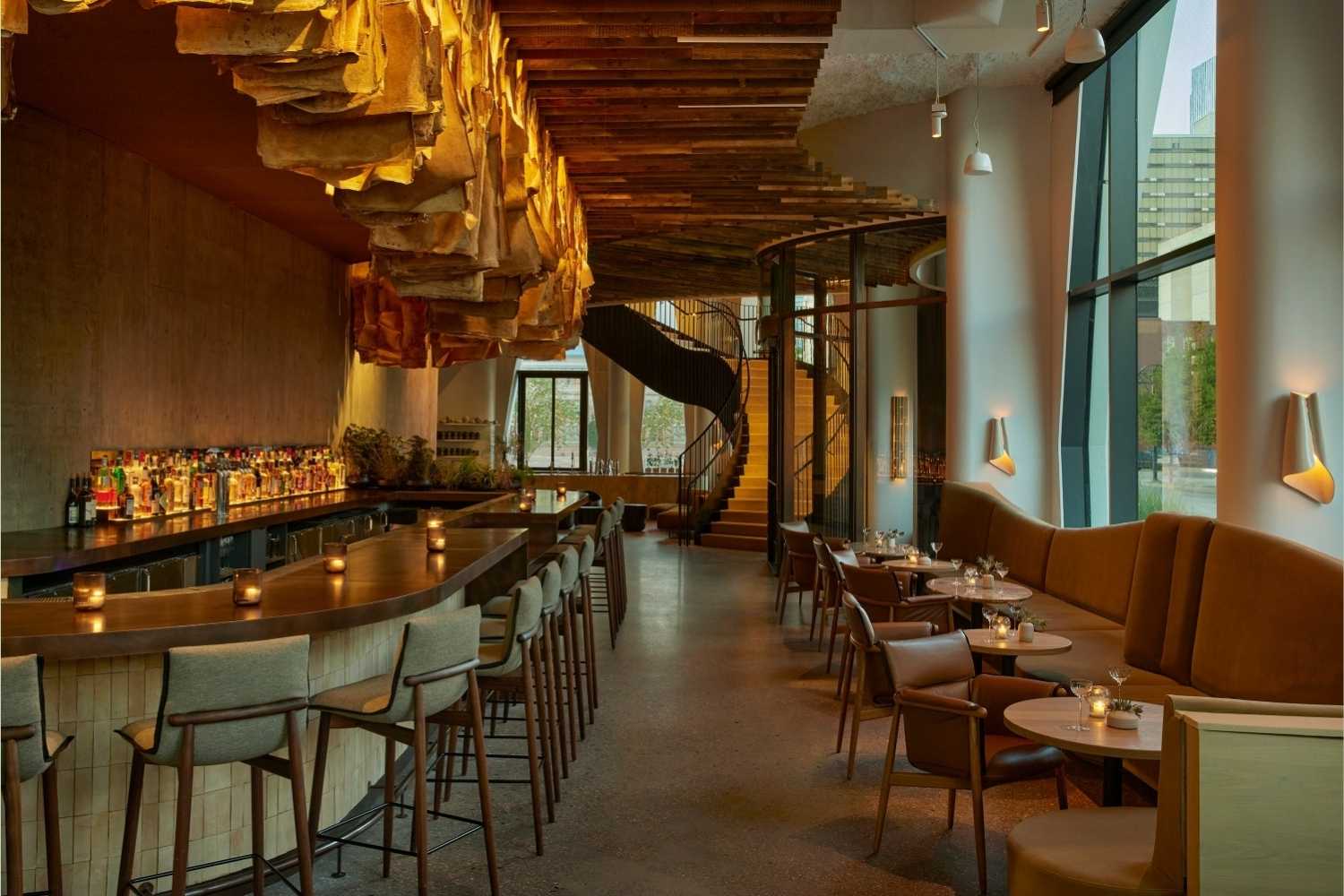
Pasque Restaurant. Courtesy of Yoshihiro Makino.
Sustainability Chops
Populus’s environmental work happens on several levels, most of it intentionally out of the spotlight unless you go looking. The team started by tackling the building’s carbon footprint at the source, using a low-carbon concrete mix, a continuously insulated façade, and the hooded “aspen eye” windows that shade the glass and cut energy use as much as they define the look.
They also chose not to build an on-site parking garage, which avoids extra concrete and steel (and money) to lean into the reality that a downtown Denver hotel can be reached on foot, by transit, or by rideshare, just fine. The broader goal is ambitious: over the life of the building, their programs should pull more carbon from the atmosphere than the hotel emits.
The most guest-facing piece of this is One Night, One Tree, a partnership with the National Forest Foundation that funds the planting of one tree in regional forests for every night you stay. Those trees are planted in areas hit hard by invasive beetles and wildfire, mostly in Colorado, while additional nature-based carbon and soil projects aid partners elsewhere in the U.S.
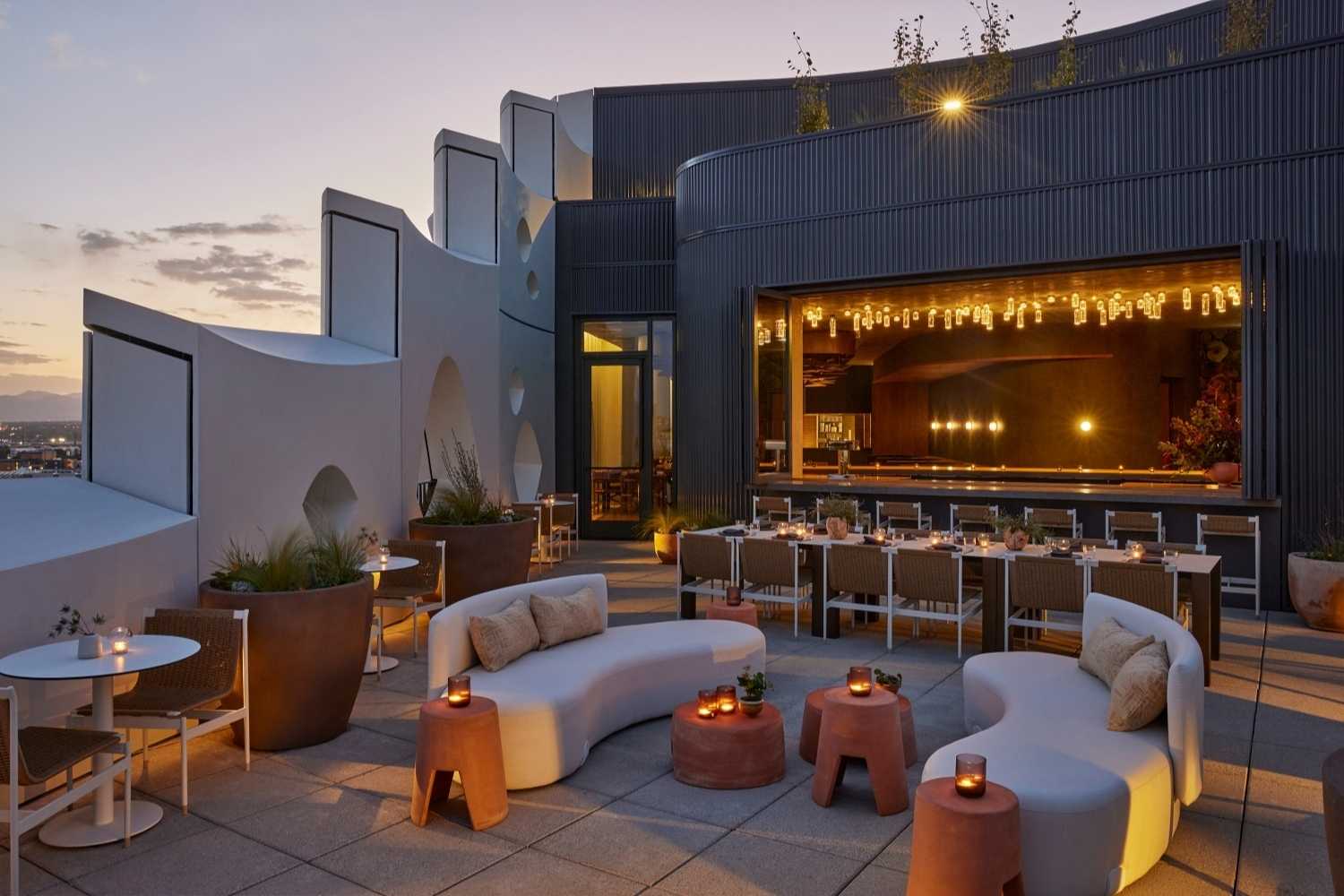
Stellar Jay Rooftop Terrace. Courtesy of Yoshihiro Makino.
Before Populus even opened, the team had already supported the planting of more than 70,000 trees on roughly 172 acres near the La Garita Wilderness, and the One Night, One Tree program can add up to 20,000 more in a single year.
Day-to-day operations are wired for lower emissions, too. Populus runs on 100 percent renewable electricity backed by Colorado wind energy credits, keeping operational carbon lower than a typical downtown property. In the kitchens, both Pasque and Stellar Jay send all food scraps and plate waste through a BioGreen360 “food cycling” system instead of to landfill; a waterless digester uses microbes and heat to turn leftovers into all-natural compost that goes back to local farms, closing the loop from table to soil.
On top of that, a portion of restaurant sales is directed to regenerative agriculture projects that help Colorado farmers improve soil health and lock more carbon underground, so the hotel’s food spend feeds back into the landscapes it relies on.
To keep all of this from living only in marketing copy, Populus has brought in Lotus Engineering & Sustainability, a third-party firm that tracks embodied and operational carbon, energy use, waste, and offsets over time. The “carbon-positive” claim is tied to an actual dashboard rather than a one-time press release, which is about as close to accountability as a hotel can get.
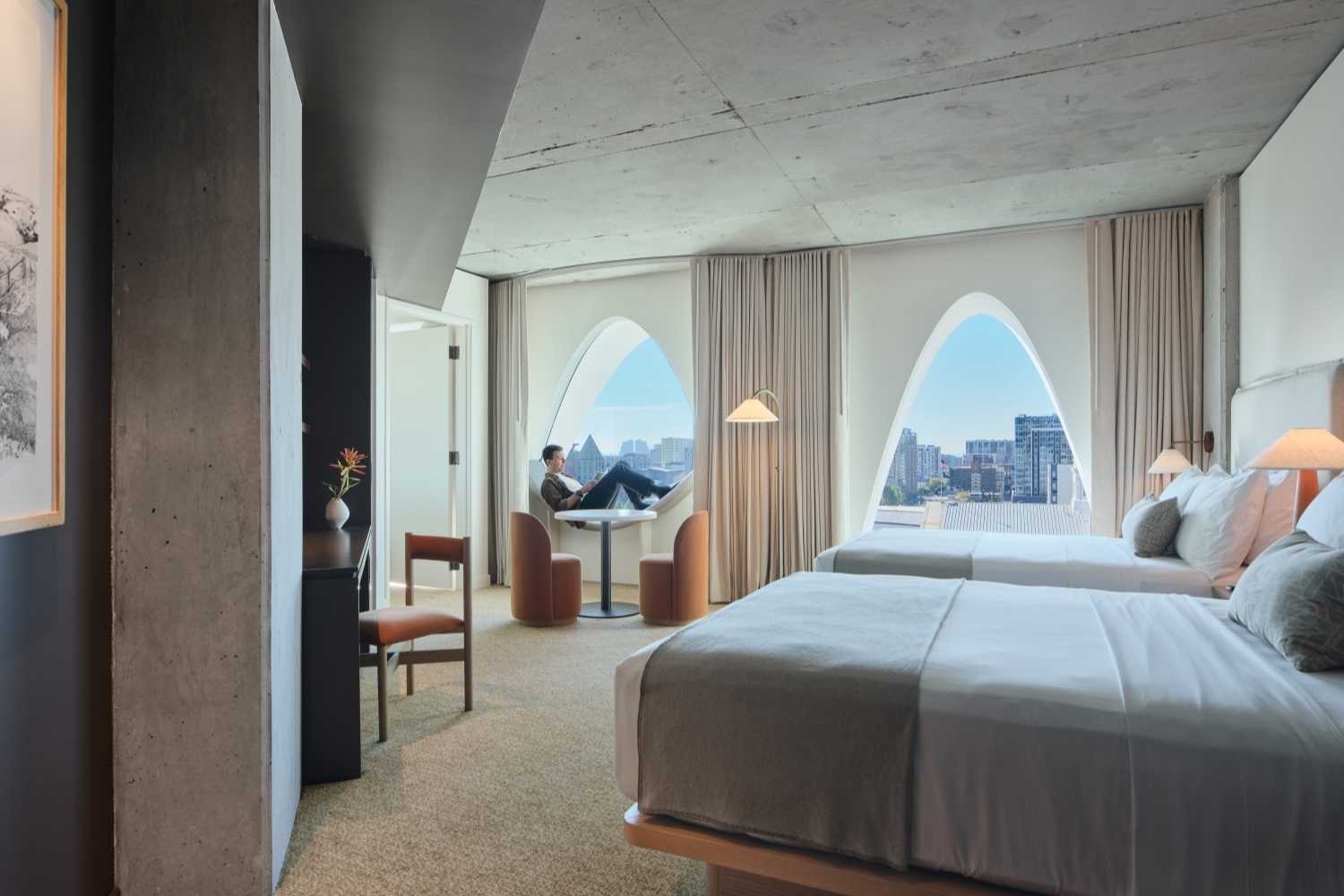
Populus Guest Room. Courtesy of Studio Gang, Steve Hall.
Who It’s For
Travelers who care about design and climate, but still want a proper drink, a real mattress, and a good steak if the mood strikes. Populus suits solo business travelers who would rather not sleep in a bland corporate or convention hotel.
Location
Populus sits on 14th Street, a short walk from Civic Center Park, the Denver Art Museum, and the Colorado History Museum. The immediate blocks feel quiet and office-heavy rather than glamorous, though that workaday backdrop makes the bright, aspen-inspired tower even more striking.
Practically speaking, Populus provides an easy base for exploring. You can walk to key cultural spots, pick up light rail or rideshares, and reach neighborhoods like LoDo, RiNo, and Capitol Hill in a quick ride for more eating and drinking options. For the in-between hours, the hotel’s own coffee bar, ground-floor restaurant, and rooftop give you plenty of reasons to stay put.
Rooms
Guest rooms feel like serene treehouse rooms for grown-ups, with wood, concrete, and the shape of the walls and windows doing most of the talking. The windows become the key focal point, framing slivers of Denver, from neighboring roofs to the distant Front Range, depending on the room.
Furnishings are simple and calming in subtle earthen hues and soft textiles with compact desks or tables, and enough seating for work or reading without crowding the floor.
Bathrooms are straightforward, with refillable, plant-based bath products instead of single-use minis. In the corridors, water stations replace plastic bottles in the room, a clear nudge toward refilling rather than tossing.
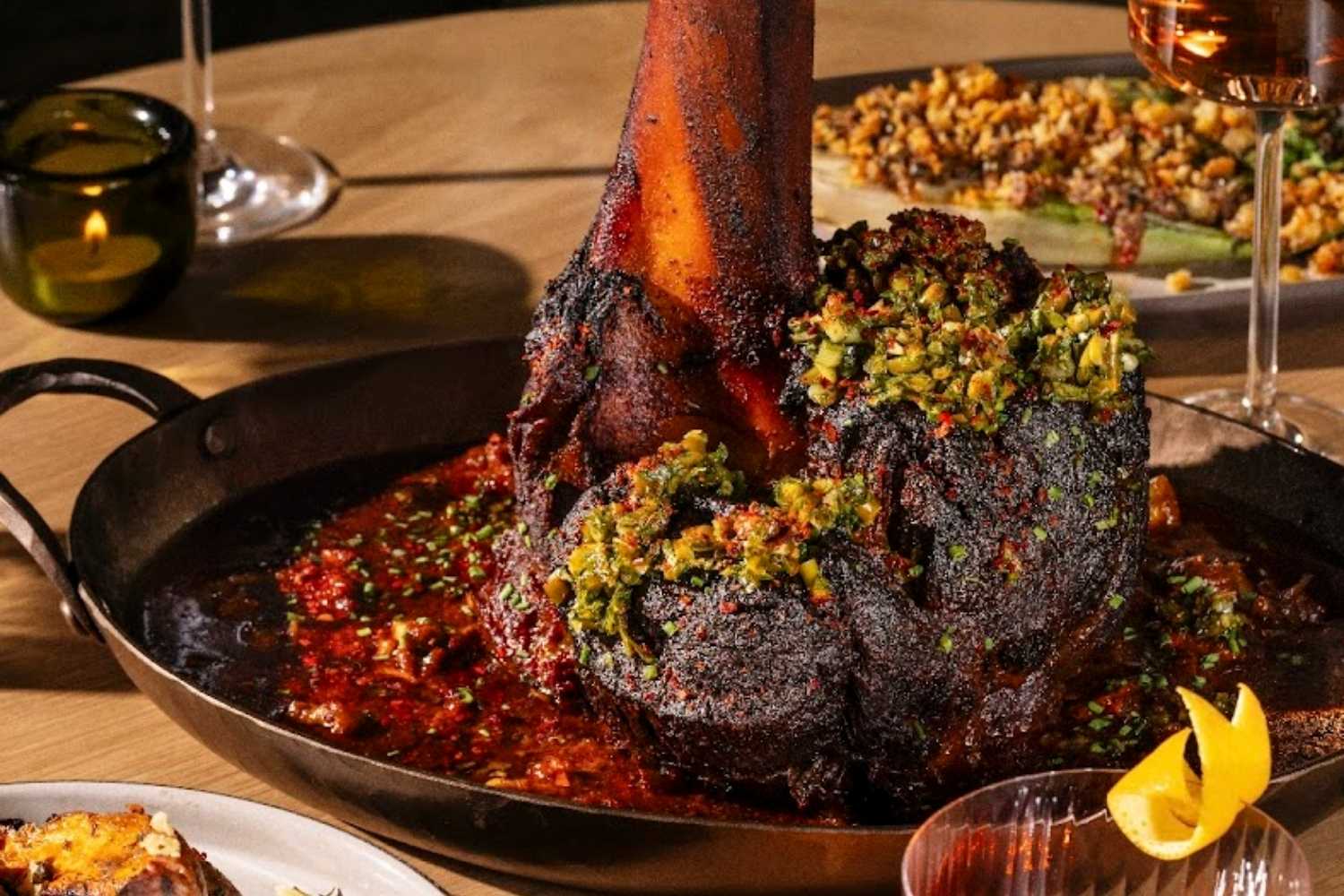
Stellar Jay Thor's Hammer Bison Shank. Courtesy of Alanna Hale.
Food and Drink
On the ground floor, Pasque does double duty as the hotel’s daytime dining room and downtown meeting spot. Breakfast is where you see the mix most clearly: guests with keycards in their pockets, suits with laptops open over coffee, and a menu focused on plant-forward dishes without feeling puritanical. Seasonal vegetables and grains show up in grain bowls, salads, and sides, with regional meat and seafood layered in rather than the star of the plate. The restaurant is also where much of Populus’s waste strategy becomes real, thanks to an on-site BioGreen360 system that turns all food scraps into compost bound for local farms instead of landfill.
Little Owl’s café, on a mezzanine space over the lobby, serves third-wave coffee as filter and espresso-based drinks. Sorry, no pour overs here, though they sell single origin bags of coffee to take home.
In the evenings, the action shifts upward to Stellar Jay, the rooftop restaurant and bar. Inside, the room opens onto a terrace with wide views across the city towards the Rockies. It’s an obvious choice for a drink around sunset, and the whole city knows it. Arrive early for the best spots.
Inside, the dining menu centers around live-fire cooking, so vegetables, seafood, wild game, and larger cuts of meat all catch time over the flame. Rock River Ranch bison appears as a T-bone meant for sharing, while a 14-day dry-aged Flannery ribeye comes spiked with fried rosemary, a reminder that “carbon positive” still includes serious Colorado meat, though sourced more carefully. The cocktail list runs from agave and mezcal drinks to a blood orange margarita with blanco tequila, agave, lime, and a salt-or-Tajín rim, which is hard to argue with when the sky is going pink over downtown.
Populus Lobby. Courtesy of Studio Gang, Steve Hall.
Staff & Service
Service feels more Brooklyn than buttoned-up luxury, which suits the building. At the front desk and in the restaurants, the tone is conversational but competent: enough guidance to get you to the right gallery, bar, or hiking trail, without anyone hovering. Staff can explain the basics of the One Night, One Tree program and the food-waste system in a couple of sentences if you ask, then move on to whether you want a late checkout or another drink. The overall effect is edited but human, which keeps the “concept hotel” piece from feeling like homework.
Amenities
Populus is set up as a city hotel rather than an urban resort. There are meeting and event spaces on the lower levels for small conferences or off-sites, plus plenty of seating in the lobby and mezzanine for laptops, calls, or a drink between plans. Little Owl, Pasque, and the rooftop mean you are never far from a coffee, a snack, or a full dinner, even if you decide not to leave the building.
Outside, the hotel has invested in landscape as infrastructure. Street trees are planted in Silva Cells under the sidewalk, which gives their roots proper soil volume to grow larger than typical downtown plantings. Trees, of course, will eventually improve shade and air quality on the block, as they mature. On the roof, a planted garden adds more greenery and habitat to a part of the city that is otherwise mostly concrete and glass.
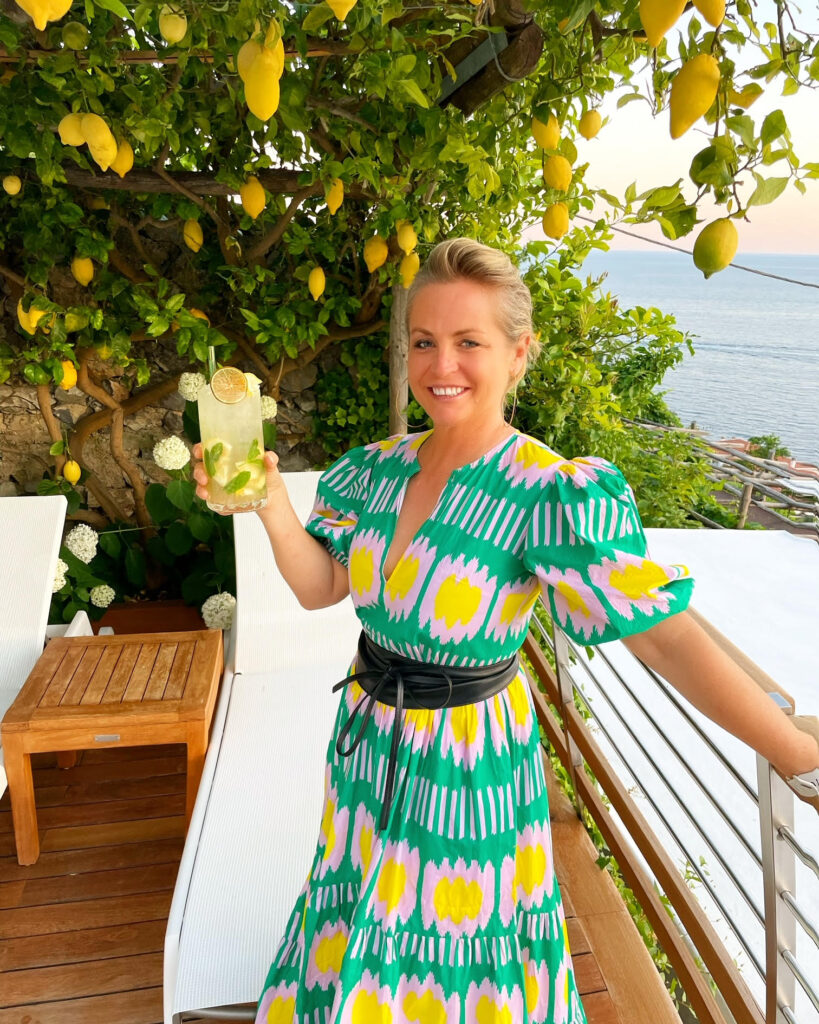
Founder and CEO of Azure Road, Lauren Mowery is a longtime wine, food, and travel writer. Mowery continues to serve on Decanter Magazine’s 12-strong US editorial team. Prior to joining Decanter, she spent five years as the travel editor at Wine Enthusiast. Mowery has earned accolades for her writing and photography, having contributed travel, drinks, food, and sustainability content to publications like Food & Wine, Forbes, Afar, The Independent, Saveur, Hemispheres, U.S. News & World Report, SCUBA Diving, Plate, Chef & Restaurant, Hotels Above Par, AAA, Fodors.com, Lonely Planet, USA Today, Men’s Journal, and Time Out, among others.
Pursuing her Master of Wine certification, she has also been a regular wine and spirits writer for Tasting Panel, Somm Journal, VinePair, Punch, and SevenFifty Daily. Mowery is a graduate of the University of Virginia and Fordham Law School, and she completed two wine harvests in South Africa.
Follow her on Instagram @AzureRoad and TikTok @AzureRoad
North Stars: Carbon Footprint, Energy Efficiency, Waste Management