North Stars:

Community Support

Waste Management

Gender Equality
“Shoe making, at its core, is a skill in problem-solving.“
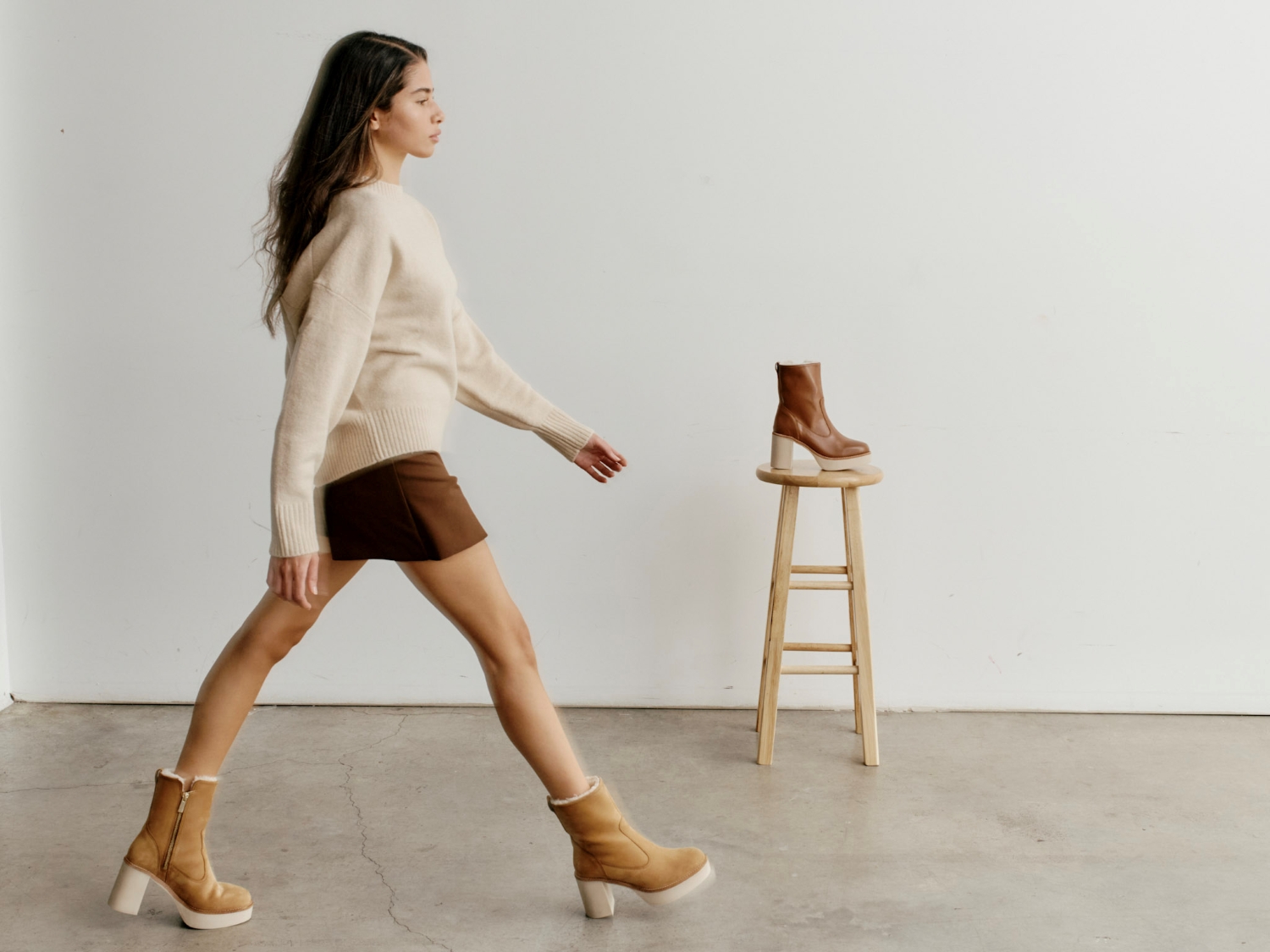
Model walking in the Aspen boot. Courtesy of Daniella Shevel.
The Azure Road Take
Daniella Shevel has called shoe design a problem-solving skill. She usually applies that line to her heels, but it feels even more apt for winter boots. A cold-weather boot has to handle slush, black ice, and long days on your feet, all while looking office- or party-ready, something you actually want to wear. The Aspen is her answer to that puzzle.
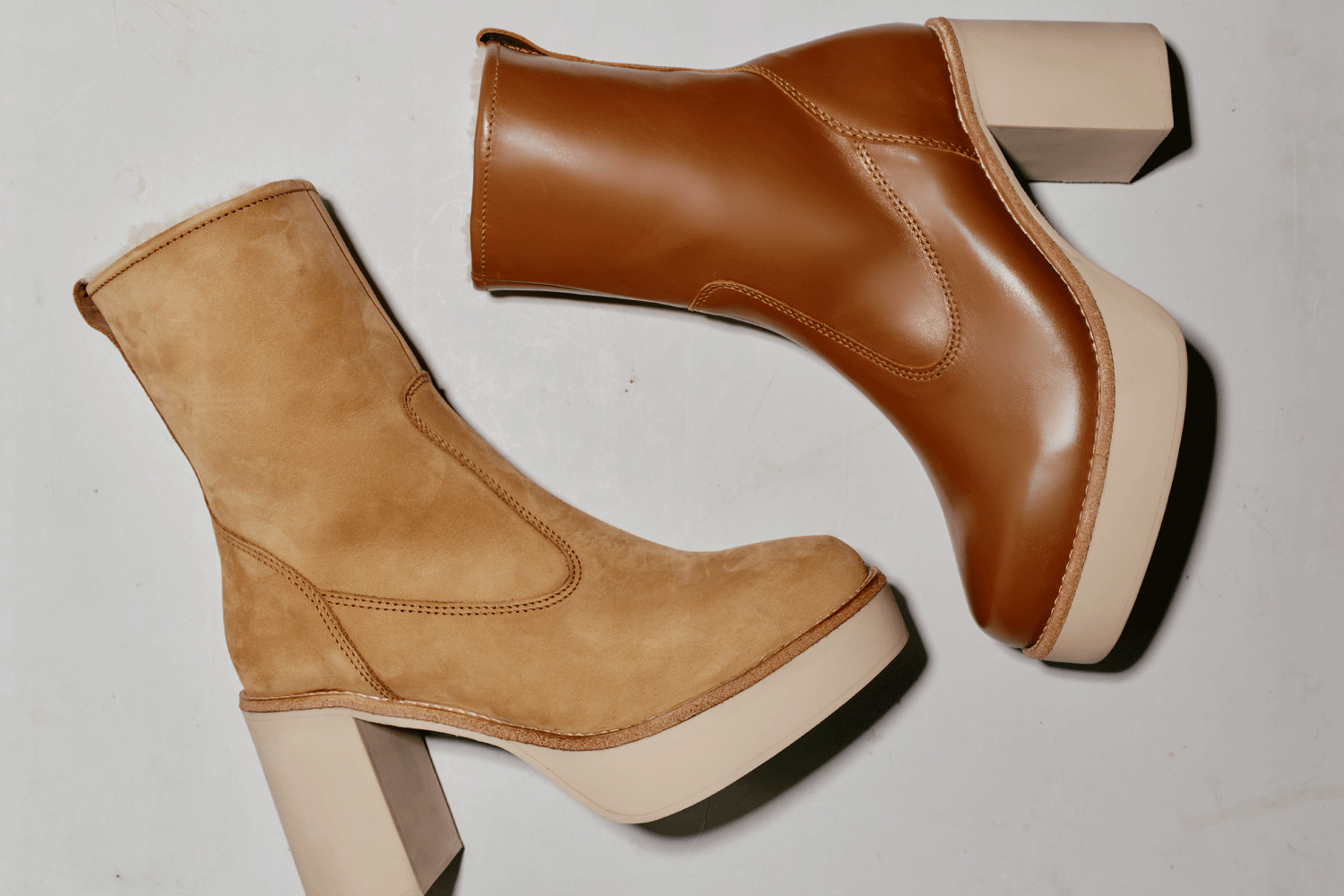
On the foot, the Aspen sits in that rare space between “serious weather boot” and “actual outfit.” The upper curves in at the ankle so it follows the line of the leg instead of chopping it off, which makes it more flattering than most cold-weather options with straight-leg denim or a wool skirt. A whisper of shearling at the top signals warmth without tipping into cartoon après-ski.
Visually, it reads “city-meets-mountain.” In brown, the Nappa leather has a warm, polished finish that holds its shape yet softens over time. It looks equally at home with a long tailored coat in New York or stepping off a plane into an actual snowstorm.
For those of us in warmer places (Charleston, SC for me), this boot also performs across three seasons. It is warm without being too toasty and stands up to rain, so it earns its keep for seven or eight months of the year.
(For sustainable summer styles, check out our suggestions.)
Sustainability Chops
Shoes are one of the hardest categories in fashion to make low impact. They are built from layers of different materials, held together with glues and hardware, and must withstand heavy wear, which makes recycling and material separation at the end of their life difficult. Very few brands can honestly claim a fully traceable, low-footprint boot. Shevel does not present Aspen as that. Instead, she concentrates on the parts of the process a small label can realistically influence.
Shevel hand-picked smaller, often family-run factories in Brazil and Italy to produce her shoes. Working at that scale means she is not sending thousands of speculative pairs into the world. She tends to refine and repeat successful shapes rather than rebuilding the collection every season, which slows the usual trend cycle. Aspen is also built as a long-term piece: it is welted and set on a solid rubber sole so it can withstand several winters and be re-soled instead of being discarded after a few hard years.
The brand’s most concrete initiative addresses what happens at the end of a shoe’s life. Through a partnership with Soles4Souls, customers can send in old pairs, from any label, to be redistributed or resold through micro-enterprise programs rather than thrown away.
To encourage participation, the company offers a $75 credit for every five pairs donated, or a $75 credit for every $250 given directly to Soles4Souls. At checkout, shoppers can also opt into carbon offsets via EcoCart to help counter the estimated emissions from production and shipping.
Aspen is not a fully circular, certified “perfect” boot. It is a thoughtful one from an independent brand that is addressing waste, overproduction, and product longevity with a buy-less-but-better point of view. Additional details can be found in the site’s sustainability statement.

Daniella Shevel Aspen Shearling in Black. Courtesy of Daniella Shevel.
The Look
Aspen comes in black, mocha (a warm brown), stone white nappa leather as well as a nubuck suede finish. The boot sits on a 3.6-inch (92 mm) heel with a 1.2-inch (29 mm) platform, which provides height without the sharp pitch of a standard high heel. The shaft measures 6.7 inches (172 mm), high enough to cover the ankle and hold in warmth without fighting most trouser and skirt lengths. A thick rubber lug sole provides traction in rain, snow, and frost.
The interior of the boot comes with a full shearling lining in a sherpa-like, high-pile finish. Inside, a three-part memory-foam system and an insole covered in memory foam allow the boot to mold to the foot and ankle over time for a contoured, cozy fit. A leather welt, custom nickel-free hardware, and an interior zipper keep the exterior clean while making the boot easy to take on and off. Each pair is handcrafted in Brazil.
In terms of size, I wear a 7.5 and found the same size in the Aspen mocha to fit perfectly. The boot is designed to mold to the foot and ankle over time. However, the brand suggests going up half a size if you plan to wear thicker winter socks or prefer a roomier fit.
Functionally, Aspen can serve as a single, high-heel winter boot for someone who wants warmth without sacrificing height or style. It works with denim and a long wool coat, with leggings on travel days, or with a ribbed knit dress and opaque tights for evenings out.

Founder Daniella Shevel in her NYC. Courtesy of Daniella Shevel.
Origin Story
Shevel grew up in Johannesburg, relocated to California as a teenager, and later worked in digital marketing for brands such as Rag & Bone and Shopbop before launching her own line of shoes in 2018. Her interest in footwear dates back to a trip to Las Vegas in her teens, when she walked into a Jimmy Choo boutique and saw a pair of black and neon-orange heels with a bold, sculptural shape. She described that shoe as a “chair for the feet,” and the idea of footwear as small-scale architecture stayed with her.
Her namesake brand translates that idea into shoes made for everyday life. Signature styles such as the lace-up Belladonna boot and the mesh-front Romi heel share sculpted lines, stable heels, and soft materials, designed for women who actually walk, commute, and travel in their shoes rather than slipping them on for short, point-to-point transfers. Aspen is the cold-weather extension of that approach, a three-season boot that borrows the proportions and attitude of a heel while behaving like a weather-ready staple.
As a small independent label with production lines in Brazil and Italy, Shevel has felt the strain of recent tariffs. “It’s been really tough. The tariffs hit us fast and hard,” she told me, explaining that unexpected duties on pairs already in production drained cash flow and forced her to cancel fall e-commerce launches.
That context matters. When you choose a boot like Aspen over a cheaper, disposable option from a larger brand, you help keep a founder-led business alive, one that is focused on comfort, quality, and reducing waste over chasing volume and trends. The most practical way to support designers like Shevel (budget allowing, of course) is to consider buying fewer pairs and wearing them longer rather viewing footwear as a seasonal throwaway.

Founder and CEO of Azure Road, Lauren Mowery is a longtime wine, food, and travel writer. Mowery continues to serve on Decanter Magazine’s 12-strong US editorial team. Prior to joining Decanter, she spent five years as the travel editor at Wine Enthusiast. Mowery has earned accolades for her writing and photography, having contributed travel, drinks, food, and sustainability content to publications like Food & Wine, Forbes, Afar, The Independent, Saveur, Hemispheres, U.S. News & World Report, SCUBA Diving, Plate, Chef & Restaurant, Hotels Above Par, AAA, Fodors.com, Lonely Planet, USA Today, Men’s Journal, and Time Out, among others.
Pursuing her Master of Wine certification, she has also been a regular wine and spirits writer for Tasting Panel, Somm Journal, VinePair, Punch, and SevenFifty Daily. Mowery is a graduate of the University of Virginia and Fordham Law School, and she completed two wine harvests in South Africa.
Follow her on Instagram @AzureRoad
North Stars: Community Support, Gender Equality, Waste Management