North Stars:

Community Support

Waste Management

Heritage Value
“We make fashion alongside people whose roots are in the same earth from which they sustain themselves.“
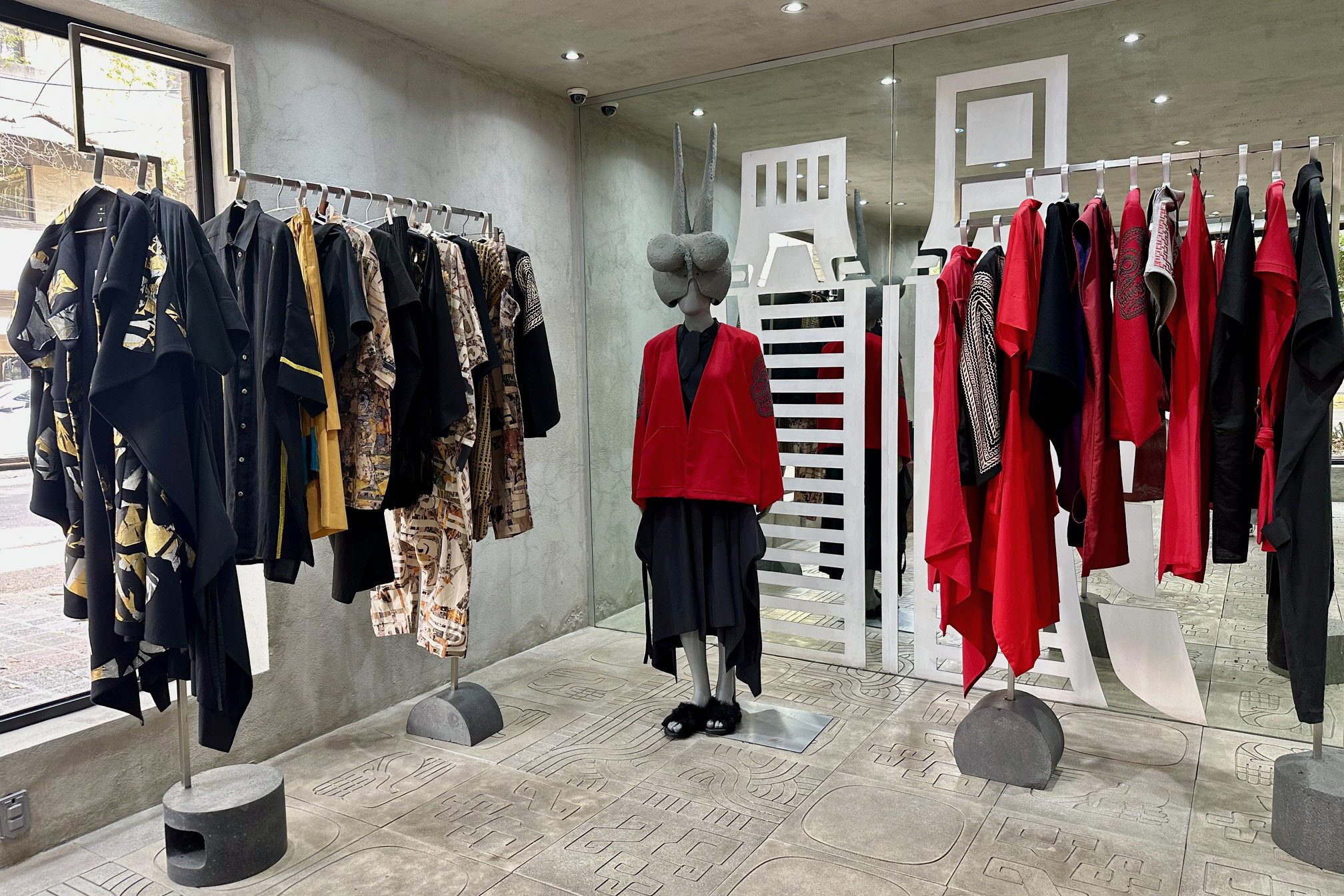
Carla Fernández shop in Juarez. Courtesy of Lauren Mowery.
The Azure Road Take
From the street in Roma or Juárez, the Carla Fernández shop can look like a funky little outpost on a gritty block: metallic sheens in the window, sharp shoulders, sculptural coats that seem closer to architecture than clothing. At first glance, it reads as a niche destination for people who collect statement pieces and don’t mind looking a bit like they’re on their way to a gallery opening.
Up close, the picture changes. Labels and wall text point to specific communities, regions, and techniques; seams reveal straight, modular pattern pieces; you start to see woven panels and rectangular cuts rather than trend-driven designs. Rather than sketching first and hunting for fabric later, Fernández begins with the logic of Indigenous Mexican textile construction and works outward, building her silhouettes from traditional pattern systems and weaving methods developed with artisan partners. Voluminous coats, geometric dresses, and modular separates are engineered to respect the original cloth instead of carving it into wasteful templates.
The Charra Cape sits neatly in that world: a compact cape that carries the line and leather work of charro dress into something that adds a touch of casual style to outfits day or night.
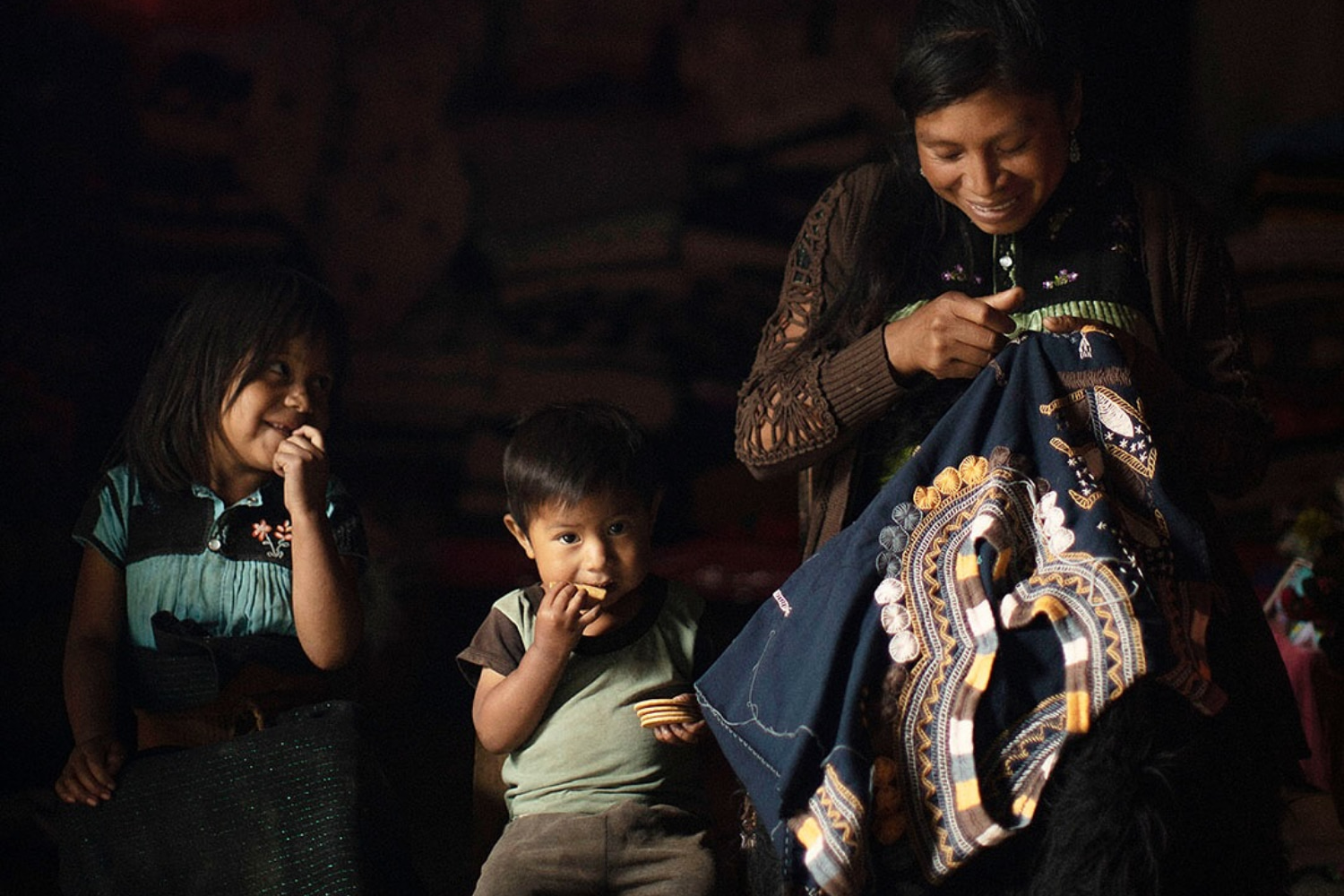
Artisan craftsmanship meets modern design. Courtesy of Carla Fernández.
Sustainability Chops
Carla Fernández is a fashion house based in Mexico City dedicated to preserving and revitalizing the textile legacy of Indigenous and mestizo communities of Mexico. The team works with artisans who specialize in hand weaving, embroidery, dyeing, leather work, wood carving, and other manual techniques, and builds collections around those methods rather than outsourcing them to anonymous suppliers.
The company collaborates with more than 175 artisans from 15 Mexican states, often through a traveling studio model that brings the design team to the communities where these techniques are already practiced. Projects are developed in creative and productive collaboration, with embroidery, weaving, and other handwork treated as integral to the design, not as surface decoration added later. The work helps sustain specific techniques and creates ongoing income for the people who use them.
Artisans are paid not only for their handwork but also for the intellectual property of designs created together, which is still rare in fashion. The business is also a Certified B Corporation. Taken together, it is a model built on heritage, long-term relationships, and small-scale production to create iconic pieces meant to last.
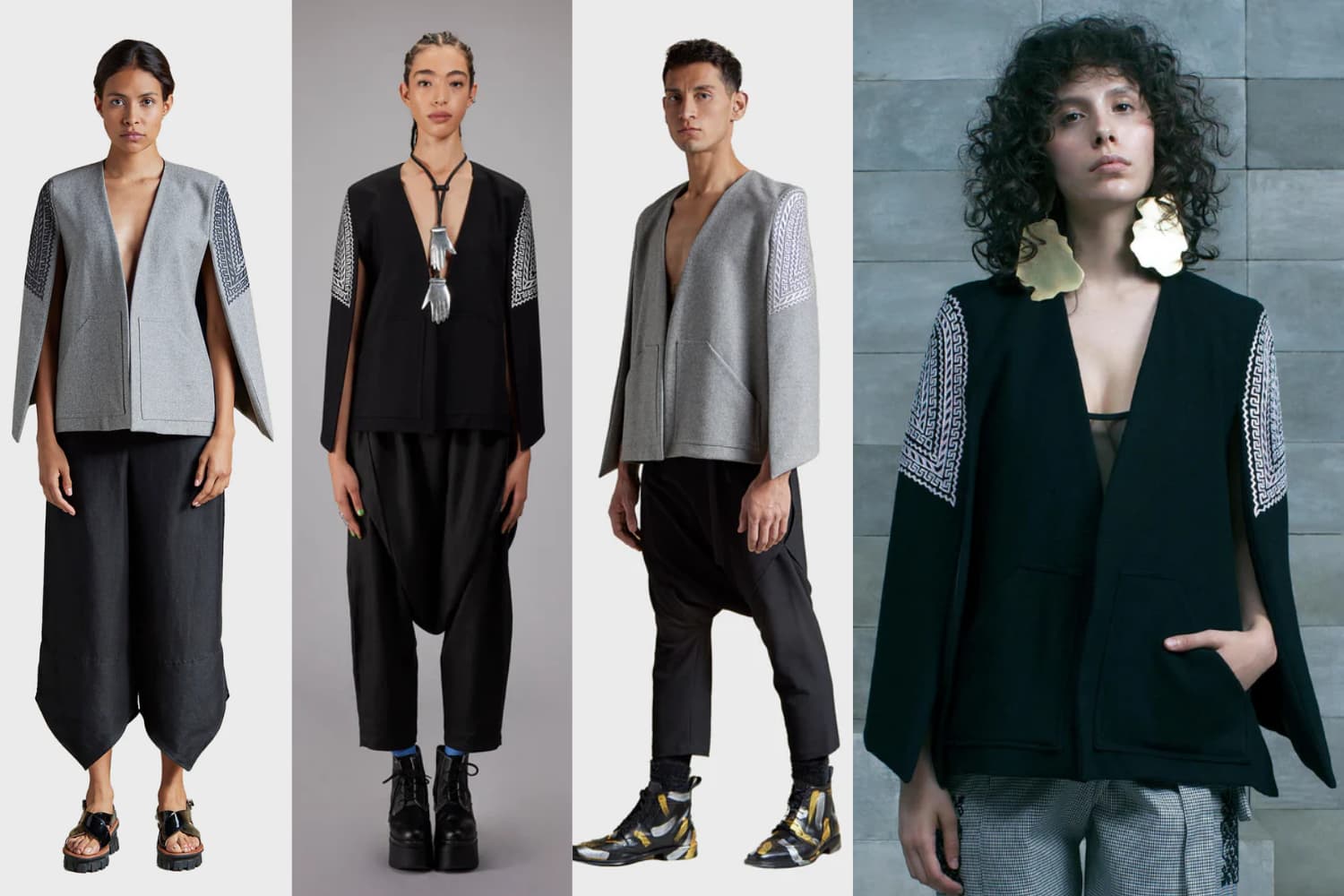
Charra Cape – Iconic Pieces. Courtesy of Carla Fernández.
The Look
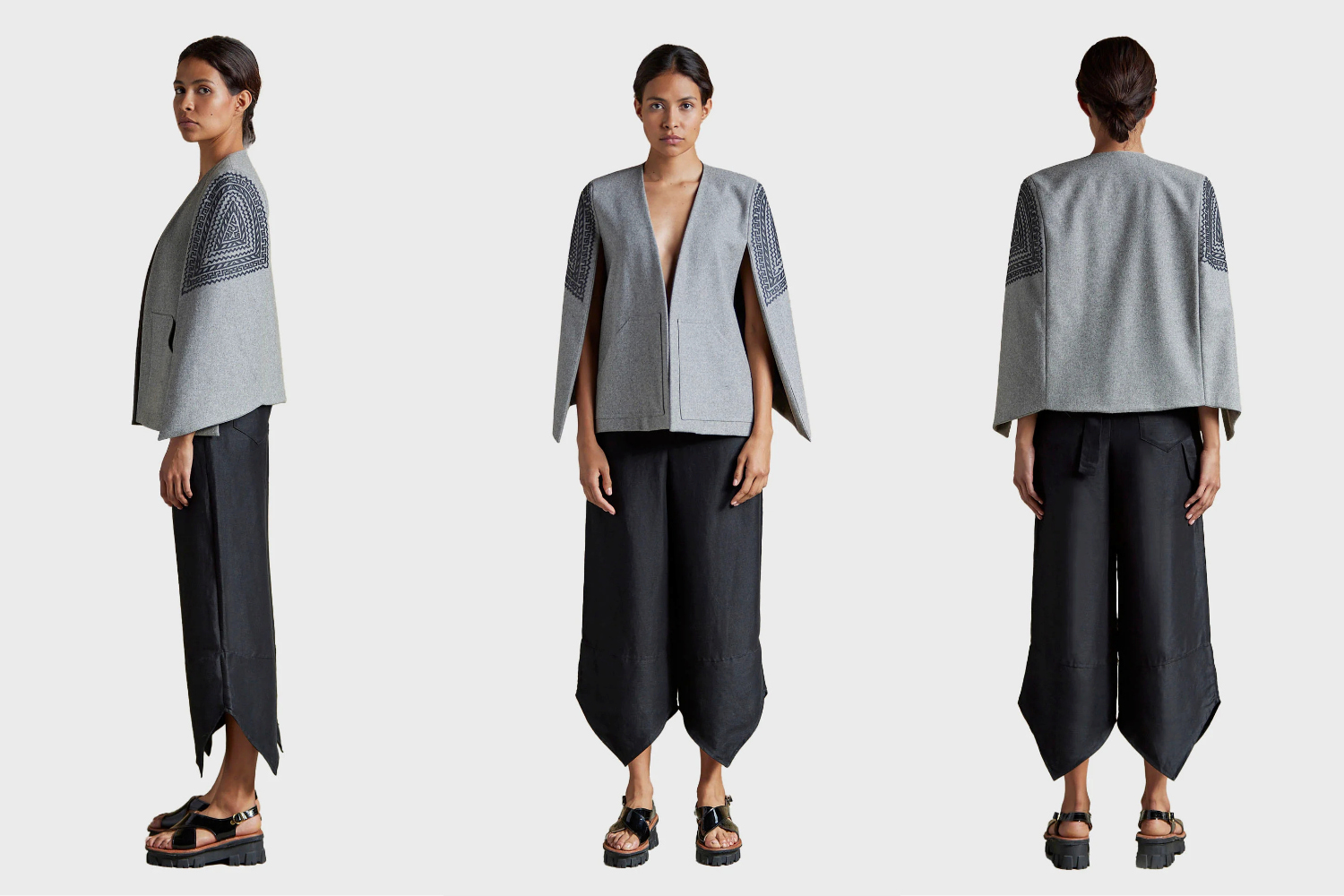
The Capa Charra is a short wool cape with a V neckline, two front pockets, and curved shield-style sleeves. The hem sits roughly at the upper hip, so it layers over trousers, jeans, or long skirts without swallowing what’s underneath. The shoulders are shaped so the cape stays in place when you walk, carry things, or sit, rather than sliding around the way less structured capes often do.
The fabric feels soft but firm, a dense blend of 83 percent wool and the rest from other fibers. Color options include grey with black leather, black with gold leather, and black with silver leather.
The leather decoration that traces the sleeves and pockets comes from a technique called calado de piel. It grew out of charrería, Mexico’s traditional equestrian sport, where charros wear fitted wool suits reinforced with hand-cut leather so the lasso rubs against leather instead of shredding the cloth beneath. Those formal outfits are still worn each year in communities such as Chimalhuacán in the State of Mexico.
In some versions of the Capa Charra, that leather cutwork takes the form of strict geometric patterns. In others, it outlines small skull motifs. In the black-and-gold or black-and-silver combinations, those shapes read almost like tiny gilded emblems, giving the cape a sharper, more modern edge while still sitting firmly inside the language of charro dress.
The Charra Cape currently retails for $660 USD.

Carla Fernández. Courtesy of Carla Fernández Cape.
Origin Story
Carla Fernández was born in Saltillo, Coahuila, and later studied art history in Mexico City. After working on projects that supported craft techniques in Indigenous communities, she began documenting how different regions draft, cut, and construct their garments, treating those systems as design knowledge rather than anonymous “folklore.”
That research led to Taller Flora, a fashion label and mobile design laboratory she founded that travels throughout Mexico to visit Indigenous communities, especially cooperatives that specialize in handmade textiles. Taller Flora researches clothing production systems and runs workshops so artisans can develop new designs using techniques they already own, while maintaining fair-trade networks and allowing people to make a living in their home regions.
Alongside Taller Flora, she built the eponymous Carla Fernández fashion house, which turns that archive of patterns and methods into ready-to-wear collections. Over the past two decades, her work with artisans has been presented in institutions such as the Denver Art Museum, the Isabella Stewart Gardner Museum, Museo Jumex, MUSAC in Spain, and others, and she has received awards including the British Fashion Council’s Young Fashion Entrepreneur prize and the Prince Claus Award, recognizing both design and social vision.
Her large-format book Manifesto of Fashion as Resistance gathers those ideas into print. It marks 15 years of the Carla Fernández fashion house and 30 years of collaborative creative and productive work with artisans across Mexico, spanning more than 80 craft techniques in 16 states.
Founder and CEO of Azure Road, Lauren Mowery is a longtime wine, food, and travel writer. Mowery continues to serve on Decanter Magazine’s 12-strong US editorial team. Prior to joining Decanter, she spent five years as the travel editor at Wine Enthusiast. Mowery has earned accolades for her writing and photography, having contributed travel, drinks, food, and sustainability content to publications like Food & Wine, Forbes, Afar, The Independent, Saveur, Hemispheres, U.S. News & World Report, SCUBA Diving, Plate, Chef & Restaurant, Hotels Above Par, AAA, Fodors.com, Lonely Planet, USA Today, Men’s Journal, and Time Out, among others.
Pursuing her Master of Wine certification, she has also been a regular wine and spirits writer for Tasting Panel, Somm Journal, VinePair, Punch, and SevenFifty Daily. Mowery is a graduate of the University of Virginia and Fordham Law School, and she completed two wine harvests in South Africa.
Follow her on Instagram @AzureRoad
North Stars: Community Support, Heritage Value, Waste Management